
What a week! How many times have you reached the end of a weekend and though that to yourself? This past week really had me up, down and sideways, which always makes me step back and look at things differently.
 I’ve thought a lot this week about hoping and wishing for things. There was a situation in my personal life that looked like it was going to work out better than we had expected, but then it just didn’t pan out the way we had hoped or wished. It seems to be the way of life for us, and you’d think we would learn to not expect anything at all. After all, it would be easier to not hope for anything and be pleasantly surprised, than it would be to think something is going to work out and have it fall through. Does this sound like days, weeks, or even years you have experienced in your own life? When I consider the possibility of abandoning hope or expectations that things will work out, it flies in the face of what I have believed. I’ve always believed God is working everything out for my ultimate good, but what happens when you feel let down over and over until you stop asking for things?
There are a lot of televangelists who tell us we can ask for anything from our Heavenly Father, and I agree that’s true. We have every right and privilege to ask, but we must remember that sometimes the answer is wait, and sometimes the answer is no. Just because we ask for it, doesn’t mean it is best for us. Sometimes what is best for us is something totally opposite of what we ask. In theory, and as people of faith, we know this to be true but it can be so incredibly defeating and discouraging when it happens over and over. It is certainly easy for me to start looking at things differently and question why I even ask in the first place. I start becoming a spiritual “realist” and soon I’m not asking for anything anymore because I’d rather not be disappointed…again.
 When my situation came up this past week, it looked like God was doing something above and beyond for us, but then it didn’t happen. Do you know what that made me think? I started thinking “here we go again; God must be disappointed in us to dangle this out there and then yank it away.” I was totally disappointed in God and it temporarily undermined my trust in Him. Yep, my so‑called faith took a tumble into the abyss for a little while. But why? Because my perspective was out of whack on two points:
- Our initial problem had actually been resolved far better than we thought possible, and I was thrilled, but then came the possibility for even greater things. When those things didn’t happen, I developed “spiritual amnesia!” I no longer felt the same gratitude and excitement when my initial prayers were answered. Once a possibility for more existed, it shifted my mindset into hoping and wishing for what I believed was greater or better.
- The possibility of greater things was something I attributed to my impression that God was going above and beyond, instead of realizing the enemy could be using this extra aspect to distract me from being grateful for already answered prayers. And it worked.
Once I began thinking negative thoughts about who God is and who I am as His child, everything started to tumble down the rabbit hole right behind it. I didn’t stop with being disappointed over the present circumstance, but rather continued ruminating on every disappointing circumstance in my life – now or in the past. I became overwhelmed and depressed. I told myself I was going to become ambivalent in my prayers and requests to God. You can imagine the thought process: “If I just ask for things but then don’t expect anything in the answer, I won’t be disappointed.” I started thinking maybe that’s how God actually wants me to view things – unexpectant and ambivalent. I have to admit, it was simply another depressing thought, because I couldn’t see past the darkness in which I was tumbling. The truth is “unexpectant and ambivalent” are the opposite of “trust and certainty,” but in my darkness I could not tell the difference.
 Gratitude does not come easy in the storms of life. When we start jumping to conclusions about what God is or isn’t doing in any given situation, instead of leaving things in His hands and trusting Him to do what is best for us, we often end up disappointed. The majority of our issues, however, come from thinking that the “best” means the most lucrative or easiest. Our definition of “good” and “bad” are based on what we can see with our own eyes, or ideas, but God has the vision and perspective of eternity and knows every aspect of our situations. My uncle used to say, “We don’t really want to trust God to take care of us because what if He doesn’t take care of us like we want to be taken care of?” I think that is more accurate than most of us would like to admit. God doesn’t want us to get so conditioned by life that we lose our passion, joy and peace. He doesn’t want us to ask Him for things and not care what the answer is. He wants us to be content in the outcome of our requests as a result of understanding who He is and how much He loves us, not because we simply stopped expecting anything from Him.
Look, God knows we are human and that we are going to experience disappointment, hurt, betrayal and many other emotions. He also knows it is our tendency to let it overwhelm us. The shortest verse in the Bible is John 11:35 and it simply says, “Jesus wept.” Lazarus had died and when Jesus got to the tomb and saw his sisters and other friends weeping, it moved Him to the point of tears as well. Jesus knew He was going to raise Lazarus from the dead and yet He still wept. He also understood that death here is temporary. He knew, better than anyone, that life continues for His children in Heaven, and yet He still cried. Why? Because knowing the outcome of the story doesn’t mean you don’t cry at the sad parts.
 As people of faith, we know that eventually everything works out for our good, but that doesn’t mean we won’t have to deal with tears, discouragement, anger or depression along the way. What matters is how we keep walking in spite of it. It doesn’t mean we won’t have times where we are so tired or discouraged that we curl up into a ball to try and catch our breath; what matters is what we do with that breath when it returns. Will we use it to perpetuate the darkness around or within us, or will we lift our voice like Paul and Silas in prison and praise the One who loves us and has promised to take care of us?
For me, I don’t want to be blinded to all the good God is doing (or allowing) in my life because of my inability to let go of what I think is “best” for me or my loved ones. I’m not saying it will be an easy thing to do or a perspective that will be easy to maintain. I’m just saying, there is no other way to truly experience the peace that passes all understanding and to live the abundant life He offers us. It’s time to change our definition of what “abundance” truly means.
Blessings!
 Although I might be dating myself with that song-cue of a title, I want to share something very important with you about an issue that is affecting more and more of us, an issue that is leaving families hurt, lost and confused about what to do or where to turn. This issue is the condition called Dementia, and it not only affects older people but people of all ages. They are even finding new strains appearing in young children. I know this is a bit of a departure from my normal posts, but it is one to which many of you can relate.
 Dementia is an umbrella term, under which fall a large number of different types of the disease. Alzheimer’s, for example, is simply the most common type of dementia, but there is Lewy Body, Frontotemporal, Vascular Dementia, and a host of others. Dementia is not a memory problem; it is brain failure. Just like any other organ can fail, the brain can experience failure. Where that failure first manifests itself will determine the functions that are the first to begin diminishing. My dad did not start out with memory problems. You could ask him about things and talk with him, never knowing there was a problem at all. We did however start to notice he was starting to struggle with problem solving, or things involving processes or sequencing. We saw the signs but never recognized them. We just blamed it on not knowing technology or being tired and stressed. Because he didn’t have any trouble with remembering people, events, stories or anything else, it never occurred to us in the beginning that he might have an actual issue going on. We were wrong.
 As of right now, there has not been a single survivor of this disease. Let that sink in for a moment. We have found ways to mitigate some of the effects of it, but it still remains a 100% fatal condition. That may sound harsh, but it is the reality. There is no currently no cure. We have done a great job in this country highlighting all kinds of diseases and raising money for research, but this disease falls through the cracks sometimes. Maybe it’s because it is often a private battle that still contains a stigma that causes people to be afraid to discuss it openly. Maybe it’s because people who would normally be out there raising money for the cause are far too busy just trying to survive from day to day as they care for their loved ones. Whatever the reason, we need to get busy doing all we can to raise money for research, while raising awareness and educating others, so that we can reduce the stigma associated with this disease.
 It all started when someone, who knows what I’ve been going through in recent months, unexpectedly came to me and said she had been reading a devotional and a verse jumped out at her that she felt needed to be shared with me. The verse was John 16:33 where Jesus said, “I’ve told you these things so that in me you may have peace. In this world you will have trouble, but take heart! I have overcome the world.” As a result, this friend made me a pendant on which she stamped “John 16:33.” Because I was so touched by the gesture, I read that verse over and over. It is a familiar verse, but all my life, I’ve focused on the last part of it, the part where Jesus says we will have trouble but that He has overcome it. THIS time, I couldn’t get past the first comment, “I’ve told you these things so that in me you may have peace.” I just kept thinking about the fact that Jesus thought it was so important to remind His followers of why He had continually shared all He did with them. It’s like He was saying to ME, “Look, there’s a reason I’ve told you all I have about life, it’s troubles and how to navigate it.” That thought pushed the chain reaction into full swing, because it prompted me to pick up my Bible so I could remember the things He had “told me” in His word. This time though, instead of turning to the many familiar passages of encouragement and promises, I returned to something I hadn’t finished reading almost three months ago – Genesis chapter 4, the story of Cain and Abel.
 So what was this epiphany I had when I read the verses telling the story of Cain and Abel? Well, I used to think of Cain as just a terrible person, an evil man who got jealous of his brother and killed him in cold blood. Not only that, but then he had the audacity to make a smart-a** comment to God Himself (Gen 4:9)! I’m not excusing anything Cain did, but I want to share a different perspective. Here were two brothers, one was a shepherd and the other was a farmer. When it came time to give an offering to God, it was supposed to be a sacrificial lamb. So, Abel provided an offering according to what God had requested, but Cain decided he would give something different. Cain decided it would be better if he sacrificed the best that HE had to God. It’s most likely that his intent was honorable, and that he thought surely it would touch God more if he sacrificed the best of his crops instead of asking his brother for a lamb to sacrifice, while giving up nothing himself. It wasn’t that he was being a disobedient jerk, but rather that he felt like God would be more pleased if he gave Him the absolute best of all he had. He was trying to honor God his way instead of simply doing what God asked. Unfortunately, he was wrong, and when God accepted Abel’s offering, but had no regard for Cain’s, it made him angry, depressed and dejected. Wouldn’t YOU be?
 Ok, so back to Cain… In my memory of this story, I somehow forgot that God actually talked to him twice, the first was BEFORE he killed his brother. Gen 4:6-7: “Then the Lord said to Cain, “Why are you angry? And why has your countenance fallen? If you do well, will not your countenance be lifted up? And if you do not do well, sin is crouching at the door; and its desire is for you, but you must master it.” God loved Cain and knew he was upset, so He took a moment to remind him of something really important: We have an enemy and it isn’t our families, friends, coworkers, church members or anyone else; it is something bigger. Ephesians 6:12 tells us that we don’t wrestle against flesh and blood, but against the power of darkness. 1 Peter 5:8 tells us to be alert and sober-minded because our enemy, the devil, prowls around like a roaring lion looking for someone to devour. Cain’s emotions got the best of him and God knew it, so He basically said, “Look, if you simply do what I ask instead of what you think I want, you’ll have joy. But if you lose focus and start trying to do things your way, sin is crouching down waiting to pounce on you. It wants to take you down! It wants
  As I sat in my chair the next morning, blown away by what God had just revealed to me, I said out loud, “Oh my God, I am CAIN!” I realized my frustration that God’s plan was not what I thought it should be caused me to allow the enemy to leap from his crouching and pounce all over me. And then I heard God speak to my heart the same thing he told Cain that day so long ago: “I have a plan, and if you will just trust me and follow it, everything will work out. But if you let this disappointment you feel, as a result of me not doing things your way, just keep eating at you, it’s going to destroy you. You’ve got to let it go and trust me.” Talk about being humbled by something…God’s same words to Cain in his crisis of faith thousands of years ago became the same words He said to me in mine. And just like Cain, I had a choice to make in how I moved forward, but instead of holding onto my anger as he did, I chose to unclench my hands and let it go.
 Silent Saturday for the followers of Christ was a terrible day. The previous day, their Savior and friend had been brutally beaten to the point of being unrecognizable and had died a horrible death on the cross. The people who had believed in Him were crushed, scared, and worried about what the future would hold. They heard Him promise that He would rise again on the third day, but they doubted it. If they believed His promise with all their hearts, they would have been waiting expectantly at the tomb on Sunday to see it happen. Instead, they were afraid. It was extremely silent for them. Fear hovered over them while darkness hovered in the tomb. Waiting is always the hardest part.
 All of us have experienced our own personal versions of a silent Saturday. We face times in which we have lived from a place of faith in God and His promises. We hold tight to our relationship with Jesus, believing what He has said, even when we sometimes don’t fully understand it. We follow; we believe; we trust. We marvel when we see God’s hand working in our lives or the lives of those around us, but then we find ourselves in a silent Saturday. We pray for God’s guidance and help, but it seems He is silent. As a result, we wonder if He is gone and start to question what will happen to us in His absence. We feel scared and helpless; and if we are honest, we sometimes feel betrayed, as if everything we have done has been for nothing. The questions start to swirl within us, “Where is God? Why won’t He answer me? Why won’t He help me?!” The longer the silence, the more scared or disillusioned we become. Depression sets in. We hunker down and start trying to figure out what we should do to protect ourselves, because it seems God has disappeared.
 The disciples were already confused and fearful when Jesus was arrested. They watched Him willingly lay down His life even though they knew He had the power to strike back at those who were harming Him. Surely they felt like their entire world was falling apart and the future was too dark to see. Jesus was dead and in the tomb; Darkness set in and the silence became deafening. What I always found interesting was that Jesus had told them multiple times what He was doing and why He was doing it, but they just kept missing it. (Matthew 16:21 and 20:17-19) The problem wasn’t that they hadn’t been told, but rather that they never fully understood – or didn’t want to understand. Jesus even told the disciples “I am telling you now before it happens so that when it does happen, you will believe that I am who I am.” (John 13:19) How many times has the same thing happened to me because I was blinded by my own ideas of what should happen based on an incorrect interpretation of what God has said to me through His word? Just like the disciples, sometimes I can’t get out of my own way to see His.
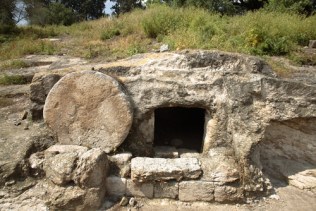 I am so grateful the darkness of the original Silent Saturday didn’t last, and that Jesus walked out of the grave – ALIVE – on Sunday morning! But this year, I am also grateful to remember that the silent Saturdays of our lives don’t last either. I’m not saying these seasons of life are easy, by any stretch, and we are all in different places of faith at different times. But just as the disciples could have benefited from reminding each other of the truth and holding onto each other in moments when the fear or sadness was too much to bear, we can lean on our brothers and sisters in Christ to do the same for us (and us for them) as we trudge through the difficult times in life.
 We’ve all heard, seen, or even experienced being in the eye of a violent storm. We’ve watched hurricane coverage on the news and marveled at those broadcasts that occur while the “eye” is passing over. Things change drastically in the eye of the storm. Raging winds calm down, torrential rains stop, and the dark clouds break to reveal the warm light of the sun. It really is a beautiful pause, but the reality is that the storm is far from over.
 I said earlier the eye of the storm is a “beautiful pause,” because that’s all it is – a pause. This temporary period of peace and calm is simply a chance to take a breath, gather yourself back together and think clearly for a little while. It’s a moment in time in which we are reminded that there IS life out there beyond the storm. It reminds us the sun is still shining and takes us to a place of hope that can strengthen our resolve in the face of knowing there is nothing we can do but endure the impending return of the storm. This eye is where I find myself right now. Standing in a place of peace, being reminded of how beautiful life can be, and creating an even deeper appreciation for every other time of calm when the storms weren’t raging. In this place of peace, it is easy to see clearly the path behind and to gain perspective on the path ahead, even though I cannot direct it.
 Sometimes we need the perspective that only the storm can bring. We can become so complacent in our “ruts” in life, often assuming we will always be able to maintain the status quo. We float through our days, almost mindlessly at times, and when the storms roll in, we are suddenly more alert. We may be scared or disrupted by what is happening, but we are no longer able to be oblivious to what is going on around us. We may endure the shakeup in our routines that come when the storm hits. We may have seen it coming and tried to make preparations for riding it out, or it may have hit us without warning. We struggle and react from a survival instinct, and it isn’t easy, but then the eye of the storm moves overhead. It is then that we have that pocket of peace where we can take a deep breath and be reminded of what it feels like when there are no storms on the horizon. We can be refreshed and even strengthened in these beautiful moments of perspective.
 If you don’t know which way to turn, don’t turn. Be steady and listen for God’s direction, but then be willing to do what He leads you to do, even when you know He is leading you into an area you’d rather not go. But if you are genuinely seeking God’s will for your life, don’t take any path off the table. We cannot seek His will or clarity in direction but then tell Him which paths we will not take. And if He is answering your prayer for clarity but you keep creating your own noise that is making it impossible to hear, then He may allow storms in to shake your priorities back into focus. He will bring you through the first half of the storm into the eye where everything falls into place, and you gain the perspective you need in order to not only survive the storm, but to come out with gratitude for the clarity. My prayer for you is the same as it is for me, that we breathe and press on with courage and total trust that all is already well, even though we can’t see it yet. No matter what the landscape looks like when the storm is over, I pray we can find joy and peace in having made it through, and have a renewed sense of strength and clarity in learning what is truly important and what is not.
 The Cadence of My Soul