
When You Don’t Feel Thankful…

shutterstock_159498437It’s that time of year again when everyone is supposed to stop and count their blessings and be thankful for all the things in their lives.  But what if things feel so bad in your life that you’ve lost the ability to see the good things, or to even believe they exist anymore?  What if you are depressed by current events or financial problems?  What if you are in the middle of a difficult or challenging situation that is overwhelming your mind?  Or what if you are experiencing sadness, hurt or disappointment that is overwhelming your heart?  What if you don’t FEEL thankful?  I ask because I need the answer myself.

Thanksgiving is supposed to be a time for us to gather together to count our blessings and remember all God has done for us.  Most of us have time off at some point for the holiday weekend where we have the opportunity to stop and reflect, but often that reflection never happens or it is clouded by all the distractions going on around us.  Thanksgiving, for many, has become nothing more than a long weekend filled with family arguments, frantic shopping, and stress of other obligations. For some, it has turned from an opportunity to relax and reflect, into four days of elevated heart rates, packed schedules and frustrated hearts and minds.  For others, it is nothing more than a reminder of what they have lost or never had in life – whether it is family, love or material possessions.

It’s hard going into the holiday season when there are things in your life that are weighing you down.  I think we’ve all experienced that sensation one year or another.  For me, there is a lot on my heart and mind.  Much of it I cannot share with anyone because it is something that needs to stay between me and God for right now, but it weighs heavily on me.  Then you add the loss of holiday traditions that I used to love, and stresses of work and home, and I find myself overwhelmed by it all.  shutterstock_213079855Then I look around, and all I see is a coming weekend of frenetic activity that revolves around everything BUT something positive.  It doesn’t make me feel very thankful at all.  It makes me feel depressed, which then causes me to start thinking about everything that’s wrong or all the stuff I need to do.  It sucks the gratitude right out of me, because the majority of the negative things I’m thinking about are valid.  There ARE things that need to be resolved, things that ARE frustrating, things that DO hurt me.  It’s all true, so how am I supposed to stop and be thankful?  We must find ways to stop the madness, both externally and internally, so that we are able to find peace in the midst of the storms and thankfulness in the midst of our chaos.  Here are some practical things to consider…

  1. Learn to say “No.” – I know it sounds selfish, but we all need to learn the word “no,” especially around the holidays. Do not commit to so many events, cooking, volunteering or family get-togethers that you are running continually from one thing to another.  It’s okay to want to do all these things, but there are only 24 hours in a day and if you do not learn to say no, you will drain yourself to a point where you cannot do any more.  Trust me, you will eventually break down in some way.  Instead, decide what is most important to you and let the rest go.  Besides, when you take it upon yourself to do everything someone asks you to do (or you think you need to do), you may be robbing someone else of the blessing of being able to step in and help or participate.  You aren’t a martyr, so stop acting like one and set some boundaries.
  2. Create your own personal tradition – Traditions can be wonderful but life happens and sometimes those traditions end up changing or even disappearing completely because they involve others. Consider creating some traditions for yourself that do not depend on anyone else.  For example, decide you are going to spend a certain amount of time doing something you enjoy.  It might be taking a walk, listening to music, getting coffee, painting, or whatever floats your boat.  Make it something you can do whether someone else joins you or not.  If you are a person of faith, you can decide to set aside an amount of time – whether it is days, hours or even just a few minutes – where you get by yourself, turn off all the technology that is constantly pinging at you, and spend that time with your heavenly Father.  It can be talking to Him or reading His word, but make it time just for you and Him.  It is GREAT to have traditions with family and friends, but make sure you have some traditions just for you that are totally in your control.  That way you won’t feel so sad or resentful when someone else fails to uphold traditions you used to treasure.
  3. Rest – I suppose this could go hand-in-hand with learning to say no, but you NEED to find time to rest. The holidays are filled with frenetic activity and even if you aren’t actively participating in all of it, the pace swirling around you will inevitably affect you.  It’s like standing in the middle of a crowd that is fighting with each other even if you aren’t fighting.  The stress of it all will still affect you even if you just stand there.  Not participating in the holiday madness, doesn’t automatically mean you are resting!  Resting is something we have devalued in our society and we need to get back to taking time to stop now and then.  Go to bed at a decent hour and rest so that you are able to truly enjoy the things you choose to do each day.  If you choose to participate in something that has you out late (or all night) then prepare and plan to take time the next day to rest, instead of engaging in all kinds of activities.  If you don’t take time to truly rest, you will find yourself much more susceptible to the natural stresses that occur during this time of the year.  Your fuse will be shorter and it will be almost impossible to not feel drained on all fronts.
  4. Pray – You can pray anywhere, any time. I’m not talking about the prayers you hear in church or on TV where it is filled with the “right” things to say and a bunch of “Lords,” “Fathers”, “thees” and “thous” but the kind of prayer that God actually takes delight in!  TALK to God.  Talk to Him like you would your best friend.  If you’re angry, then tell Him.  He already knows it anyway so you might as well be honest.  If you’re sad or confused, then tell Him.  Ask Him to help you because He has promised that He will!  You don’t have to spend a certain amount of time praying or get on your knees.  I pray all the time in my car, just talking to Him and telling Him what I’m afraid of, worried about, or need help with.  I tell Him things that I thought were funny or things that made my day.  Sometimes it is as simple as me saying, “Hey God, I was just thinking about how much I don’t want to go to work this morning, so would you please help me get through the day?  ”  That’s it.  No fanfare and no righteous verbiage.   I think He would much rather have us, as His children, just call Him like we do anyone else we have a relationship with.  He already knows everything, but when you talk to Him like you would anyone else, it makes your relationship much more real and prayer no longer feels like an obligation.  He enjoys hearing from us just like we enjoy it when our kids (or others) talk to us and want to keep us in the loop of their lives – even if we already know what they are about to tell us.  And when God becomes real to us, then everything else changes.

Listen, no one ever said life was easy.  We all have things that hit us and knock us down and steal our joy or gratitude, but making changes so that it can be restored can sometimes be just as hard.  When you start setting boundaries and taking care of yourself, there are others around you who will not be happy.  Don’t expect otherwise because it often requires them to adjust also, and change isn’t easy for most people.  There are others who will have strong opinions and be more than happy to share them with you.  They may try to make you see how “selfish you are being,” or get upset because you won’t join in everything they think you should be doing.  But you see, they aren’t the ones who have to live with those choices or who have to answer to God for them.  We are told to be thankful and to give thanks in ALL things, not just the good stuff or what we think is the good stuff.  That being said, in order to clear the clutter out of your head and heart so that you are able to be thankful, you have to sometimes make difficult choices or change the way you approach things. Taking some of those steps listed above may initially cause stress for others but the bottom line is you are not responsible for everyone else.  You are responsible for doing whatever is necessary so that you can prepare your own heart to be reminded of everything that you truly do have.  That is often easier said than done.
shutterstock_223186420There is much for which to be grateful.  If you’re reading this, it means you woke up this morning.  It means you took another breath.  It means your heart beat another time.  That means anything is possible today, tomorrow, or any time to come.  What’s in the past is past, and the possibilities are endless for the future, but you will never be able to step back and appreciate that truth without a conscious effort.  You can’t wait until you FEEL thankful, because the cares of this world will absolutely choke you until you can’t see anything else.   You will never begin to feel thankful until you actually become thankful, and becoming thankful is something we should all strive for. When we take care of ourselves (in all areas), our hearts become softened to the whispers of our Father.  When we rest, we are able to contemplate.  When we reflect and contemplate on things, we begin to see the true meaning of life and nature of God.  And when we see the true nature of God, we cannot help but become thankful.  Becoming thankful is a choice based on what we know to be true.  Once we become thankful, we begin to feel thankful, and it is then we are able to deepen our roots so that we are able to reach out in greater ways to the world around us and share a true spirit of gratitude and love.  And that, my friends is what thanksgiving is all about.

Blessings!

I Like Big “Buts”…

And I cannot lie.  If you’re truthful with yourself, you could probably say the same thing.   Most of us have heard things like “If ‘ifs’ and ‘buts’ were candy and nuts, we’d all have a merry Christmas!”  Boy, isn’t that the truth?  But where “ifs” come as a result of speculation and wishing, “buts” come from a very different place.  “Buts” come from a place of excuses and self-deception.  For example, we all like to sit around and wish and dream of things being different in our life or in our world (“IF I could just save more money, I’d be less stressed”), but we seldom do anything about it (“BUT I just love to shop.”)  The first part of that sentence is a factual statement about what you would like to do.  The second part, though also factual, is your way of rationalizing behavior that will always prevent your dream from coming true.

shutterstock_211760386“Buts” steal our joy and strength in every area:  emotionally, physically, financially and spiritually and cause us to waste our time always stuck in the world of “ifs.”  I have news for you; that doesn’t make you a “dreamer,” it simply makes you lazy.  Am I a dreamer? Absolutely!  I love to think about possibilities and ways to make the world better, but if I never take steps to actually make the world better, then I am no longer a dreamer;  I am an “iffer.”  A dreamer can stretch out into the land of possibilities and come back with amazing ways to do accomplish those things; an “iffer” simply lives in the land of possibilities with no intention of coming back and making things different.  We should never degrade the term “dreamer” by making it a costume for our “ifs.”  True dreamers seek ways to bring their dreams to life, where “ffers” simply seek dreams as a way of escaping life, and that’s where the “buts” come in.

“But” is a conjunction that is used to introduce something contrasting with what has already been mentioned.  From a spiritual standpoint, it can often be said that whatever comes after the “but” is sin.  That’s because we use it in the following mindset (fill in your own blanks):  “I know I should do _____ but ______.”  We make statements regarding things that God has put in black and white (or red and white) that He wants us to do.  How many times have you heard these types of statements come out of your (or someone else’s) mouth?

  • I know I should serve God, but I don’t have the time.
  • I know God wants me to have a relationship with Him but it takes too much energy.
  • I know I should give, but I don’t have enough money.
  • I know I should love my enemies, but they don’t deserve it.

And then there are statements around things that we feel called to do, but cannot get a direct answer written in black and white in God’s word:

  • I believe God wants me to teach, but I don’t speak well.
  • I feel called to join the choir or worship team, but I just don’t have time to practice.
  • I believe God is moving me into another line of work, but I’ll make less money.

There are so many things that we miss out on in life because of the word “but.”   As a person of faith, it is one of the most damaging words we can ever utter.   It is far more damaging than other words we use because it neutralizes us.  It neutralizes our relationship with God, and it neutralizes our witness to others.  It keeps us confined and holds us captive, and yet I have to admit far too often that I like big “buts.”

shutterstock_189351380The truth is, “buts” make me feel better about myself, or at least create the illusion for me that I feel better.  They put a nice-looking coat over the rags of disobedience, unfaithfulness or even fear.  They make me feel better about acting wrongly or making improper decisions.   “Buts” also make me feel validated about things I fear.  Instead of admitting I’m scared to step out on faith, I use the word “but.”  For me personally, I have felt called to preach, teach and minister to others since I was about 10 years old.  Being a woman, there are some (maybe even many) who would try to tell me God reserves the call of any kind of public ministry only to men.  I, however, believe it is up to God to call whoever HE chooses to the service He has actually created them to undertake.  I have believed for over 37 years that God was calling me to a greater depth of service to Him in these areas, but I might lose friends over forging ahead especially when the opportunities may be scarce to do so.  People might criticize my choices, even if I believe I am following God’s call.  Actually there is no “might” about it; people WILL criticize my choices when it doesn’t align with their opinion of what I should do or be.  So instead of leaping completely into what I feel called to do, I dabble in it.  I go through stages of full commitment until the thought of what I might lose by going further scares me.  And that’s when my stutter returns.   “But…but…but…”

We use “but” like some kind of expensive perfume that we can pour over our fears, anger, disobedience, etc. to try and make it smell better.  I say expensive, because it really does cost us so much when we use it.  The truth is if we didn’t like “buts” so much, we wouldn’t use them so often.  It just goes on and on, and then we complain that our lives are full of stress, debt, poor health or poor relationships.  If we could remove the negative use of that word from our vocabulary – if I could remove it from mine –my life would start changing, because what we say becomes reality for us.  We need to start owning our decisions, including the thought process that leads up to them!  Quit making excuses, and start putting a period after the first half of your statements.   If you say, “I believe I need to do ____,” then put a period at the end of that phrase and consider how you can accomplish what you believe you need to do.  If you don’t feel strong enough to move forward yet, then at least call it what it is after the word “but.”  Say “I believe I need to do ____, but I’m too scared” or “but I choose not to.”

shutterstock_199190972I’ll leave you with this: there is a way to redeem the word and use it to EMPOWER you!  Change your thinking.  Start using the word “but” to contrast your negative statements instead of your positive ones.

  • I’m afraid to step out on faith, but God said He would always be with me.
  • I’m worried about my finances, but He has promised to take care of me if I seek Him first.
  • Someone hurt me, but I will not let them keep me from loving others.
  • I have wasted so much of my life, but today is a new day.
  • I haven’t fulfilled my dreams yet, BUT nothing is going to stop me now!

“But,” in itself, is neutral.  It’s what we do with it that makes it positive or negative.   It’s my prayer that we can all start living the life of which we’ve always dreamed.   It’s time to let go of the past and move forward.  It’s time to get off our “buts!”

Blessings!

A Death Grip on the Torch

shutterstock_4720285We’ve all heard the phrase “passing the torch” when it comes to passing on our responsibilities to someone else.  We pass the torch in our careers, volunteer organizations, churches and even our own families.  It is the nature of the cycle of our lives.  But what happens when we (or others) seem to have a death grip on the torch?  What causes people in one generation to not be willing to let go and trust the ones coming up behind them?  And what are the repercussions?

In my experience, I have found three main reasons why people find themselves with such a death grip on the torch:

  1. Being preoccupied.  We haven’t taught, trained or led someone to come behind us.  If we are honest with ourselves, we would find that most of the time we are pretty full of ourselves.  We think we are indispensable in our jobs, churches and other organizations.  It’s as if we think we are going to live forever, so we don’t give much thought to who is going to step up when we are unable to do these things any longer.  It is a failing that many of us have at times.  We are so caught up in trying to accomplish things and be the people that we think we are supposed to be.  As a result, we don’t give enough thought and time to the people we should be leading and teaching so that when we are gone, things will continue.  After all, that would take even more work, and we are far too busy to do that!
  2. Pride.  We don’t think anyone can do it as well as we can.  As a result, we don’t even attempt to invest any time or energy in building up the next generation.  We continually look at them as inexperienced or even incapable of doing the things we do.  We dismiss their ideas because, after all, WE have the life experience to know better.
  3. Fear.  We fear that someone coming behind us, even if we know they’ve been taught and are capable, may have very different ideas than we have.  The truth is they WILL have different ideas than we do as to what is good or what will work.  Instead of considering their opinions, we take their ideas and the potential change as a threat.  “This is the way we’ve always done it.”  “No, we don’t need a new program in the church.”  “You need to settle down and not be so excited about things.  We like the stability of our rut in this organization.”    These fears, though they may be a result of our own past experiences,  are not always godly.  If we don’t let the people coming behind us make decisions, we are doing them, ourselves, our organizations and this world a huge disservice.  And when we don’t allow people to step up and start taking more responsibility (which includes making decisions), we cripple them and eventually kill the very organization we are trying to help.

shutterstock_191238839When it comes to churches, I’m not a proponent of free pizza and beer parties to get people in the door.  That being said, if we don’t allow the youth to meet God where they need to instead of where WE need to at 40, 50 or 60 years old, then they will go somewhere else.  They will find someplace that is relatable for them.  It’s not wrong to let the next generation step up and make decisions.  We’ve taught them commitment; we want them to be committed.  We want them to take initiative, get involved and get fired up.  We want them to be invested, but the moment they try and do anything, or even talk about doing anything, we shoot them down because we think we know best.  And the truth is, many times we do know best.  Sometimes we know exactly what will happen when they step out and do what they are proposing, but if someone didn’t let us step out on our own and make some of those same decisions (or even some of those same mistakes), we wouldn’t be where we are today.  We would not have the knowledge or the wisdom that we have.  The truth is you can preach and talk to the next generation until you are blue in the face, and some of it will stick, but some of it won’t because our talking doesn’t match the actions they see us taking.  Even if we’ve been faithful as parents, aunts/uncles, mentors, teachers, and even if we have done everything as well as we can, they still have to step out for themselves.  And when we reach back to pass the torch to them, but then don’t let go when they take hold, we end up burning ourselves.

Let’s not struggle with our need for control.  Let’s build the leaders behind us.  Let’s be an example for them, not of traditions, not of man-made exalting, but of trusting God.  Let’s live our convictions and trust God to take care of them and guide them exactly as He has done for us, even if it means changes to our routines or even our world.  Let’s pray for them, support them, and be there for them as voices of wisdom.  But let us NOT use our experience as a weapon of control to hold them captive to our own preferences or ideas simply because we do not like change. Let us love them with the love described in 1 Corinthians 13.

shutterstock_104902931We don’t need to pour water on their fire, but instead fan the flames.  We don’t need to pass a bucket of water to them, we need to pass a torch burning with fire and let them take it so they can feel the energy of what it’s like for THEM to leap out and trust God.  It is through their own experiences with God that they will energize their generation.  Churches and other organizations today don’t look like they used to, and churches/organizations tomorrow won’t look like they do today.  The sooner we understand that, the sooner we will realize the power of a living God who never changes, no matter what our society does. He is still the same yesterday, today and forever.  His power is exactly the same, and He will reach through whatever the cultural customs may be and touch the hearts of those who seek Him.  He’s been doing it since the beginning of time and will not cease until He returns.

Consider this, depending on where you are in your life’s journey:

  • If you have already passed the torch, or are in the process of doing so, be willing to let go and trust the leadership you have shown and the example you have been to those behind you.  Let go of the torch and trust them to take hold and run forward with it.  Don’t struggle with it, or become angry, bitter or critical because you think you can still do things better.  Pray for the next generation, for them to be open to God’s leading.  Pray for yourself that God will reveal new ways for you to support and encourage them…even when they make mistakes.
  • If you are following along behind someone bearing the torch, pay attention.  Talk to them; find out why they do what they do.  Learn the history of the torch they bear so it becomes personal to you.  Support and encourage them, instead of thinking they are old-fashioned and don’t know anything.  Look through the differences of age or culture and see the truth behind the external methods.  Don’t let your frustration with “old” things blind you to some of the value they might hold.  Be patient and develop your own embers on the inside so that one day, those embers can be ignited when you are handed the torch.
  • And if you are the one holding a torch right now of any kind, recognize the huge responsibility that comes with it.  Make sure you are carrying it faithfully and authentically.  But make sure you are looking to those coming behind you and teaching them how to step up when it is time for you to move on.  You owe it to everyone who is counting on you right now to BE the torch-bearer.

shutterstock_161649257A “death-grip” on the torch eventually results in the death of whatever cause, church, or organization for which it is being carried.  May we all take a long, focused look at ourselves and make sure we do not contribute to the death of the torch.  Let us not snuff the flame through our laziness, apathy, or need for control…but let us stoke the fire and cheer on those who are willing to step up and carry it forward.

Blessings!

When The New Wears Off

shutterstock_153587168We’ve all had times when we get something “new” in life.  Maybe it’s a new car or house.  Maybe it’s a new job or hobby.  Maybe it’s a new relationship.  Whatever it is, there’s nothing like the newness that comes with certain types of changes.  Even the support we receive from those around us has a different feel when it is new.  But time has a way of making us all complacent.  We get used to the things we have or the people in our lives and then find ourselves missing that “new smell” of the things with which we have been blessed.  Yep…the truth is the new always wears off.  The question is, “What do we do when it happens?”

New things or people energize us.  New circumstances excite us.  New challenges inspire (or test) us.  No matter what the effect, the result is that things are NOT boring.  There is a higher level of activity, even if it is only internally.  I think of things I have done over the course of my life and each one brought great amounts of pleasure and intensity in the beginning.  I have been excited as I jumped into creative projects or endeavors at work.  It’s interesting how people are drawn to newness.  The excitement (or stress) of things in my life has drawn others to jump in with me at times.  There is something about being in the same boat with someone who is inspired and filled with passion.  But after a while, the same things that once excited or interested others begins to fade, and they seem to wander on to the next exciting thing.  When that happens, I must remember that the newness of me or my world has simply faded for them.  It doesn’t mean they don’t care; it just means they’ve grown accustomed to it all.  I cannot allow the actions of others to dictate my passions.  I cannot and will not allow the complacency of others to determine whether or not I will continue to unleash my creativity or give 100% to the areas in which I have responsibilities.  But what about when the newness wears off not just for them, but for ME?

shutterstock_145922459Life is an exciting adventure overall, but that doesn’t mean every single moment will be filled with exciting circumstances.  Living richly from day-to-day requires something deeper than that “new car smell!”  For example, if you sold your car every time the new smell dissipated, you’d be changing cars every couple of months (if not sooner).  It just isn’t feasible to do that for most people.  If you quit your job every time you had a bad day, you’d eventually run out of new places to work.  Even our relationships have ebbs and flows and sometimes we start longing for the excitement of a new connection.  There is something beautiful about new things.  Newness reminds us of life and how amazing it can be.  New things are clean and shiny.  They smell good.  They feel good.  New relationships awaken all our senses and we feel alive!  It is natural and great to experience these sensations, but when our life begins to revolve around them, we have lost sight of what it means to live with a richness that is elusive to so many.

We have to learn to look deeper and find meaning in the beauty that comes with being steadfast.  We need to adjust our vision so that we stop taking what we have for granted, including the people in our lives.  And we need to adjust our perspective so that we don’t take it personally when others do the same to us.  I’m not saying it isn’t difficult when you feel like you are pouring yourself into the world around you, yet it seems everyone just gets used to it and finds nothing special in it anymore.  It IS difficult…but it isn’t unusual.  You aren’t alone in feeling that way.  We ALL have to live with what is left when the new wears off.

shutterstock_154285019When it’s all said and done, it is important to realize that time and troubles have a way of wearing off the new over and over, but WE have control over how we react to it.  Instead of striving for perfection, learn to appreciate the character of imperfection.  People pay large sums of money for antiques that are far from perfect.  They are weathered (and sometimes even smelly) but it is their endurance through time that makes them beautiful.  They aren’t desired because they are the newest, fanciest, most advanced items.  They are sought after because they have stood the test of time.  They have increased in value because of their longevity and resulting character.  Each scar on the antique actually is the mark of a story, a reminder that life is to be lived and not preserved.

So let us live each day from a place of character.  Let us stand strong in the face of complacency – whether it is ours or it belongs to those around us.  Let us not bow our heads when we are seemingly forgotten, unappreciated or taken for granted.  Let us live with such passion that our value to this world lies in what we do AFTER the new wears off.

Blessings!

Living in the Center of His Wheel

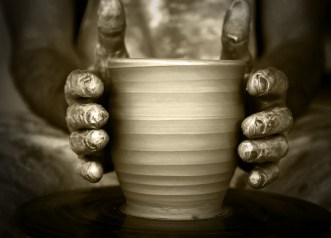
shutterstock_164791247Many people of faith are familiar with the story of the potter and the clay found in the Bible (Jeremiah chapter 18).  We’ve heard the account of how the potter was working to create something, but the clay became marred.  Instead of thinking the clay was ruined or worthless, or instead of getting frustrated and giving up, the potter simply started over remaking the clay into a useful vessel.   Often this story is used as an example of how God never gives up on us, and that is a good and proper picture, but I was thinking about a more specific aspect of the work of the potter that stands out for me.  Pressure.

If you’ve ever worked with pottery (and I have), you understand that it takes complete and total focus.  You also understand that one of the most frustrating things is when the clay gets off-center and becomes out of balance.  You are going along, trying to create something beautiful, but the moment it is out of balance, everything starts falling apart.  Sometimes it happens so quickly, and you find yourself with nothing but a lump that is unrecognizable.  Or maybe as the wheel spins, you find a rock or some other hard substance that can’t just be worked around, and you have to stop everything to remove it and then start over from the beginning.  Either of these things can be disappointing or downright maddening because you only have two choices: 1) Get mad, give up and throw the clay away, or 2) form the clay back into a lump, put it back on the wheel and start over.

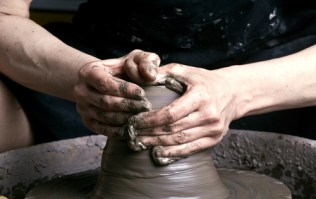
shutterstock_97981301It is interesting to consider the change in the amount of pressure a potter must use in order to make the clay into something recognizable, useful and beautiful.  In the beginning, even if the clay has been placed in the very center of the wheel, it starts to become out of balance when the spinning begins.  The potter uses water to make the clay easier to mold, then wraps his hands around it and puts strong pressure in a confined manner to guide it into balance.  A vessel cannot be created until the clay is balanced and centered, but once that happens, the true artwork begins.  Throughout the process, pressure is continually applied in one way or another or to one degree or another.  It is pressure that creates the beautiful intricacies or restores the balance.  But this one thing is for certain: the potter must keep working until the vessel is complete.  There is no stopping in the middle and coming back to it later.  It must either be completed or abandoned.  And the pressure, whether great or barely noticeable, is continually necessary because even with the most masterful artist, the clay can become out of balance at the slightest touch.  When that happens, he must stop creating and spend a little time applying just the right pressure in just the right way to bring everything back into balance.  The same is so true in our lives.

We all endure pressure in life.  It may come in the form of circumstances beyond our control or as a result of poor decisions we make, but it WILL come.  When we feel the pressure, our human nature causes us to become out of balance.  We worry and fret over what we should do.  We get angry over how we have been mistreated.  We get depressed over our lack of ability to change or fix something.  We spin and spin and eventually realize how out of balance we really are.  If only we would realize that God is the master potter and we really are the clay.  He isn’t some mean ogre who is trying to make things difficult for us or punish us.  He actually said He came so that we could have life abundantly!  This world is full of situations and circumstances that will wear us down if we focus on them, but God has promised over and over that if we will simply seek Him first, He will take care of everything else.  That doesn’t mean our lives will be free of trouble, but it means we have a loving Father who is masterfully, patiently and continually creating something amazing, no matter how many times He has to start over.

shutterstock_130134731Pressure in our lives never feels good.  We try to avoid it any time we can but maybe we just need to change the way we think about it.  When we start feeling pressure in our lives, it isn’t time for us to stiffen up and fight against it.  It’s time for us to relax into the potter’s hands and let Him use that pressure for our good.   The most difficult and challenging times for us may be exactly the pressure we need to restore our balance.  The bad decisions we may have made in our lives don’t render us useless or of no value.  Our circumstances don’t destroy us because the Potter has promised to never abandon us.  (“I will never leave you nor forsake you.”  Hebrews 13:5) He has also promised to finish what He starts!  (“He who began a good work in you is faithful and just to complete it.”  Philippians 1:6).

It is important for us to remember God doesn’t cause problems or imbalance in our lives; He simply applies loving pressure when necessary to RESTORE balance.  He continually has us in His loving hands, purposely working all things out for our ultimate good.  Whatever any of us are going through right now may not feel good.  The pressure may feel unbearable and no matter how we try, we can’t seem to find a way to make things work out. We spend our energy focusing on all that’s wrong or what we don’t have and then wonder why we are fatigued and depressed.  If only we could realize the only job of the clay is to be moldable. If only we were more willing to relax, the pressure wouldn’t seem so unbearable.  If only we would spend more of our time being grateful for the fact we are in our Father’s hands, and realize He is working to make our lives amazing and abundant, we would find it so much easier to breathe.   After all, being in the center of His will really means being in the center of His “wheel.”

And the sooner we soften under the Potter’s touch, the sooner our lives shift from becoming a work of restoration to becoming a work of art.

Blessings!