
Christmas is upon us, and here I am sitting on the floor, late at night, with only the glow of the Christmas tree lights and the screen of my laptop illuminating the room. It is quiet in my home, yet somehow music keeps rolling through my head. It isn’t a song of the season, but rather the melodic cadence of a lifetime. Maybe it’s the glow of the trees, or the silence around me, but moments like this have a way of pulling my gaze away from the noise and pace of everyday life and bringing my focus back to what really matters.
 As we continue through a season that is supposed to be filled with joy and love, I look around and see stress and frustration on the faces of people around me. Drivers are out of control with anger; shoppers are pushing and shoving each other; some people are going into debt trying to meet their (or others’) expectations of gift-giving. There are also some who are living with great losses and challenges that cause all the standard holiday activities to simply disappear into the background. In a season that is so often labeled as “magical,” it becomes easy to feel everything but a sense of wonder. Busyness and activity has a way of doing that before we even realize it.
I had a hard time this year thinking of things to put on my wish list for Christmas. I honestly couldn’t think of a single thing for which I had a great desire. It’s not that I have everything I want materially; it’s just that I found myself incredibly content for the first time in a long time. Somehow in the midst of my incredibly difficult and distressing year filled with loss and change, I realized what I valued had shifted. It was only when I sat staring at an empty Christmas list that I even recognized it.
It’s so easy to spend our lives focusing on what we don’t have or what we’ve lost. This year my husband’s parents passed away just five days apart, and my own dad’s dementia escalated to the point where he had to move into a memory care community. It was devastating for us all, and my mom had to sell their house to ensure dad could stay in his new community as long as possible, as most memory care facilities aren’t covered by insurance (don’t get me started on that). Mom moved in with me and my husband, and we’ve been adjusting to our new rhythm as best we can. Loss after loss, grief after grief with no end in sight. Have you just ever had that kind of year? If so, then you understand how quickly our perspective changes. All we see is loss, because loss is all that is visible to us. Everywhere we look there is more grief and pain, more difficult circumstances, and more that is slipping (or has slipped) between our fingers. It is a natural reaction, but it doesn’t remove the negative effect it can have on our lives.
 Dementia has a way of turning everything upside down. One of the things I love about Teepa Snow, and her organization (www.teepasnow.com ), is that she continually stresses the importance of looking at what someone still has, instead of what they’ve lost. Build and foster your relationship based on things they are still able to do instead of what you wish they could still do. When you focus on the abilities someone still possesses, it frees you from the stress that comes from your skewed expectations. You can expect all day long that your loved one with dementia still has the abilities they’ve always had, but you will just be frustrated and your relationship with that person will suffer. It’s about living in the moment, taking them where they are and creating beautiful experiences for you both. I can’t help but think how that concept applies in so many other ways in life. When we try to build or foster relationships while continually focusing on what the other person has lost or is lacking, we are setting ourselves up for frustration and disappointment. We will never be satisfied, because we will always be seeing the holes instead of the substance. We keep trying to work with what isn’t there instead of what is. What a frustrating endeavor, and even more so when the relationship we are struggling with is the one with ourselves. It is impossible to build or maintain that internal relationship when we see nothing but what we’ve lost or can’t do anymore. We can’t build a relationship with ourselves with that perspective, because it will always be skewed and will never be fulfilling. From a spiritual standpoint, it becomes so easy to start blaming God when things haven’t gone right in our world, or at least what we think is “right,” and then our relationship with Him suffers also. It’s a slippery slope for sure.
So many people talk about the art of letting go, and there is definitely something incredible about releasing things that hold you back. But what about the art of holding on? We spend a lot of time trying to identify our obstacles instead of our strengths. We focus on what we need to purge from our lives instead of what we already have that needs to be fostered. I remember a comedian once said about the Bible, “Everyone thinks the Bible is a book of don’ts, but it’s really a book of do-s. And if we’d spend our time doing the do-s, we wouldn’t have time to do the don’ts.” I heard that over 30 years ago, and it still sticks with me today just as strongly, because it also applies to how we look at ourselves and others. If we would spend our time fostering (or appreciating) what we already have, it doesn’t leave much time or energy to focus on what we are lacking in skills, abilities, or even material possessions. Ask yourself these questions: What do I have to work with? Do I have a special ability or skill? Am I good at something? What are those things? If you ask people to name something they are good at, many (if not most) of them will say they don’t know. Why? Because we don’t stop to look at what we have; we look at what we don’t. We see what we wish we were, wish we had, or wish we could do. I’m not saying that we shouldn’t strive to be better people, become more skilled, get an education or go after something new. And I’m certainly not saying you can’t change. This year has been full of huge changes for me internally, and believe me, it is always possible to change. It’s possible to be freed from things that chained you in the past, but you also need to focus on what you already possess. Search your heart deeply for a moment, you know what they are. They are those things you have forgotten as the cares of this world continually try to distract you from seeing your gifts.
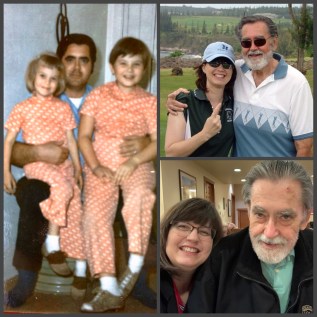 Dealing with someone who has dementia has brought so many lessons for dealing with life in general. When someone has dementia, you have to meet them where they are in order to develop and maintain a relationship with them. My dad isn’t who he used to be, and yet he is still exactly who he always was. I just have to find those things that he can still do and live in that place with him. This relationship is not exactly as I wished or hoped it would be at this stage in both our lives, but it can still be something amazing. Embracing, celebrating and being thankful for all he can still do, allows me to be open to riding this roller coaster with him instead of watching him ride alone. It allows me to live life with him now, in this moment, instead of continually seeing nothing but what has faded into the fabric of our journey. If we want to fully live, we must live in the NOW.
Work with what you have. Meet people where they are. Meet YOURSELF where you are. There are so many other abilities you may have, but those are above and beyond the fact you have been gifted with life itself. Even the ability to breathe and communicate are gifts. Trust me, you can always do something and then work from there. If you will start seeing and nurturing what you already have, you’ll be amazed at what else will suddenly appear. When you are willing to meet a dementia patient where they are, and work with what they have, it’s AMAZING how that tightly closed shell opens up to reveal the pearls within. I’ve seen it with my own eyes. If we could just do that with ourselves, what greatness might we unlock? What goals might we achieve? What dreams might come true if we will just stop jumping ahead (or backwards) and look at what we’ve lost and simply develop what we still have?
 So as we celebrate this Christmas that is upon us, let us first remember the greatest gift God gave us by coming to earth to sacrifice Himself so we can have eternal life. But let us also remember He didn’t have much from a material standpoint, but He always worked with what He had. When He called others to join Him, He worked with what they had and compelled them to do the same. Let us celebrate not just the life of Christ, but the life He wants for each of us. He’s gifted every single one of us with abilities, even when we feel we don’t have anything on which we can build. Stop for a moment. Look within and stop focusing on what you’ve lost or wish you had. Look deeply and start recognizing all you still have, every single thing you have or are able to do is a gift. No matter your circumstances or what you might see as your deficiencies, you have way more “gifts” than you can imagine.
To quote the Grinch, “Maybe Christmas, perhaps, means a little bit more.”
Merry Christmas and may you all be blessed with moments in which to live a lifetime!
 Although I might be dating myself with that song-cue of a title, I want to share something very important with you about an issue that is affecting more and more of us, an issue that is leaving families hurt, lost and confused about what to do or where to turn. This issue is the condition called Dementia, and it not only affects older people but people of all ages. They are even finding new strains appearing in young children. I know this is a bit of a departure from my normal posts, but it is one to which many of you can relate.
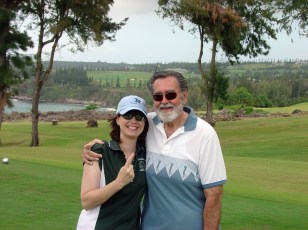 Dementia is an umbrella term, under which fall a large number of different types of the disease. Alzheimer’s, for example, is simply the most common type of dementia, but there is Lewy Body, Frontotemporal, Vascular Dementia, and a host of others. Dementia is not a memory problem; it is brain failure. Just like any other organ can fail, the brain can experience failure. Where that failure first manifests itself will determine the functions that are the first to begin diminishing. My dad did not start out with memory problems. You could ask him about things and talk with him, never knowing there was a problem at all. We did however start to notice he was starting to struggle with problem solving, or things involving processes or sequencing. We saw the signs but never recognized them. We just blamed it on not knowing technology or being tired and stressed. Because he didn’t have any trouble with remembering people, events, stories or anything else, it never occurred to us in the beginning that he might have an actual issue going on. We were wrong.
 As of right now, there has not been a single survivor of this disease. Let that sink in for a moment. We have found ways to mitigate some of the effects of it, but it still remains a 100% fatal condition. That may sound harsh, but it is the reality. There is no currently no cure. We have done a great job in this country highlighting all kinds of diseases and raising money for research, but this disease falls through the cracks sometimes. Maybe it’s because it is often a private battle that still contains a stigma that causes people to be afraid to discuss it openly. Maybe it’s because people who would normally be out there raising money for the cause are far too busy just trying to survive from day to day as they care for their loved ones. Whatever the reason, we need to get busy doing all we can to raise money for research, while raising awareness and educating others, so that we can reduce the stigma associated with this disease.
 We all have reasons and circumstances in life that cause us to retreat. It doesn’t matter the source, because the reactions are much the same. For me, it has been several years (especially the past year) of dealing with a loved one who has Dementia and struggling to leave a church I’d been part of for over 20 years. Then my husband’s parents died just four days apart. Within a matter of weeks, things substantially declined with my dad and he ended up moving into a memory care facility which resulted in my mom (whom I love beyond words) moving in with my husband and me. To say it has made my heart wander and wonder would be an understatement, yet here I am doing it more than I could have ever dreamed.
 THAT is something with which many of us are not comfortable. Stepping out of what we want into the reality that exists means we have to let go, give up, and be willing to experience the loss and grief that comes with doing so. Peace doesn’t come easy in these kinds of seasons in life. When you are between a rock and a hard place, even if only by perception, it is painful no matter which way you turn. But it’s also in that terribly lonely place that you are forced to look at what you are willing to do to be free.
 When life gets so overwhelming and you can’t breathe, sometimes it is the smallest acts of grace and kindness that get you from one day to another or from one breath to the next. Yes, there are things we must let go of to move on, and sometimes those things are deeply painful and even wounding to our hearts and spirits. It doesn’t mean we shouldn’t let go of things, people or even our expectations; it just means it’s going to take some time to heal as a result of doing so. We simply need to step back and listen to that still, small voice inside, and then walk on as peaceably as possible down the path ahead, even if the ground is stained with our tears as we move along.
 My Uncle Dewayne (or Uncle Wayne as I called him) was the most amazing man of faith and incredible teacher of God’s word. He gave up a very successful and lucrative career in construction to answer the call to full-time ministry. He earned a double Bachelor’s Degree in Theology and Bible Languages, as well as Master of Bible Languages and Doctor of Bible Languages. He was not only masterful in his study of God’s word and everything associated with it, but also in relating it to others in the most easy to understand ways. He was an incredible Pastor and Uncle, but he was an even more amazing example of what it means to live by faith. Uncle Wayne lived with the effects of Multiple Sclerosis for many years. He had continual health issues, eventually ended up in a wheelchair and often needed assistance physically. By all rights, he should have been sad, depressed, and maybe even angry at God for allowing him to suffer physically after he had dedicated his entire life to His service. Many people would have thought, “If this is what serving God and living by faith means, then I don’t want any part of it.” But not Dewayne. Nope, my Uncle Wayne always had a smile on his face and encouragement for everyone else. You could always hear him laughing from the depths of his soul or whistling as he wheeled around the church. At his Celebration of Life service, it was one of the most talked about aspects of his life aside from his faith, and yet it was his faith that allowed him to be so joyful and hopeful. How in the world was he able to keep that attitude no matter what stresses came into his life (physical or otherwise)? Well, for lack of a better statement, “He sorrowed not as those who have no hope.”
 Hope is not easy to come by in a hopeless world. Recently our Pastor brought a message on hope, and it reminded me of what Dewayne always taught: The word “hope” used in the verse “…sorrow not as those who have no hope,” isn’t the kind of hope this world has conditioned us to consider. This is not just wishing for something. We talk about hoping we get that promotion or raise. We talk about hoping something goes well. We hope our team wins the game. We hope the weather is good. We hope, we hope and we hope, but what we are really saying is we “wish.” This verse, however, uses a word that does not infer wishing, but conveys the certainty of a positive outcome. I’m not going to go into all the certainties of the resurrection or the certainty of our salvation as believers. Instead, I want to talk about this idea of being certain of the positive outcome of a situation. Romans 8:28 tells us that all things work together for our ultimate good and His glory, but when you are trudging through difficulties it’s hard to feel that way.
 I’m going to be a raw here for a moment. I miss my Uncle Wayne more than I could possibly put into words. At times it is an isolating sensation, even though I know others miss him too. The sorrow over the loss of his physical presence is even more difficult than I imagined it would be. I miss everything about having him here to see and talk with, whether it was laughing about old times, sharing music, discussing God’s word, or even just saying nothing while enjoying his company. My heart breaks every time I realize I won’t have one more hug, smile, laugh or conversation with him. It is a loss so profoundly difficult to process, but then in those moments it’s almost as if I hear his whistling drifting down from Heaven. I am reminded of what he endured in this life and how he kept his faith no matter what he had to face. I remember things he taught, but more importantly I remember what it looked like watching him actually live those very things through faith. He wasn’t perfect, but I’ve never known anyone who was a more perfect parable of what it is like to be a sinner saved by the grace of God, living victoriously through trust and faith in Him. I told someone recently that we have the perfect, sinless example of Jesus Christ on how we should live our day-to-day lives, but I was blessed beyond measure to have the most perfect example of what it looks like for an
 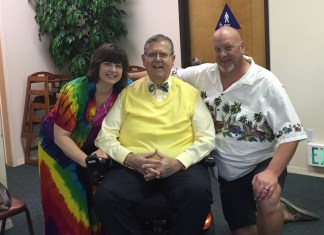 I started this post saying I have never had a loss that affected me so profoundly. It is because the way he actually LIVED affected me so profoundly. It is a multi-faceted kaleidoscope of memories and lessons that is too massive for me to be able to wrap my head around. My last visit with him was filled with more than what I could have ever imagined. His ability to keep his faith, trust and joy was so strong that it filled the room in which he was staying. It really was no different than how it filled every other room he had been in over the course of his life. He was different. He had HOPE! He knew it didn’t matter what he faced, even when he had every right to be angry or bitter, because in the end he knew he was going to overcome. He never sorrowed in this life as those who have no hope. He had hope even when MS began to make it difficult to do certain things. He had hope when he became confined to a wheelchair. He had hope when his health faltered or when he had to deal with other challenges associated with life or ministry. He didn’t just have hope, he LIVED hope! And so can we!
 The Cadence of My Soul