
 Have you ever walked through tough times in your life and come out on the other side, only to be plunged back into difficulties? It’s one of the most discouraging things in life to think you have finally hit some smooth sailing and then your boat overturns again. In my life, these times have rattled and shaken me to the core. I have felt defeated, like the sun was never going to shine again, and have often felt like maybe God is mad at me for some reason to have allowed more trouble in my life. Of course, there are all the cute quotes out there that remind us God is always good and is always working for our good. Heck, I even believe that, but man, sometimes I don’t feel it. I sit and wonder what God is up to and why there are times it feels like He yanks me out of a pleasant place only to drop me into a difficult, depressing or downright terrible place. If I’m being totally honest, it makes me question His goodness and wonder why He doesn’t just put me (or others) in that pleasant place and let us stay there. Sometimes it is life circumstances that just hit us, but sometimes God actually calls us out of the good places for a reason.
Recently I’ve been thinking a lot about a man named Lazarus. Many of you may know of whom I am speaking, but let’s take a look at it for a moment. Lazarus was a dear friend of Jesus (and also the brother of Mary and Martha). He became extremely ill, so Mary and Martha sent a message to Jesus telling Him, “Lord, the one you love is sick,” because they KNEW Jesus had the power to heal him. It probably seemed like a no-brainer that Jesus would come and heal his friend, especially since the Bible tells us that Jesus not only loved Lazarus, but also loved Mary and Martha. They were a dear family to Him, and you’d think He would immediately run to take care of it. But He didn’t. He told the messenger, “This sickness is not going to end in death. No, it is for God’s glory so that God’s Son may be glorified through it.” Then He stayed where He was for two more days before telling the disciples “let’s go back.” When they asked why, Jesus told them that Lazarus was asleep and He was going to wake him up. The disciples crack me up because they told Jesus that if Lazarus was sleeping, then he would get better. As usual, they missed what He was saying, so Jesus had to clear it up by saying, “Lazarus is dead and for your sake I’m glad I wasn’t there, so that you may believe. Let’s go.” That sounds a little harsh, but Jesus also knew his disciples needed some strengthening of their own faith.
When Jesus got to where Lazarus lived, He found that he had already been in the tomb for four days! Martha hears that Jesus is coming so she takes off to meet him. She gets to Him and says, “If you had been here, my brother wouldn’t have died!” I always feel like Martha was irritated or even scolding when she said it, like “you took too long and now look what happened!” So Jesus tells her that her brother will live again, but Martha misunderstood and thought He was talking about the resurrection. After a brief conversation, Martha goes to get Mary.
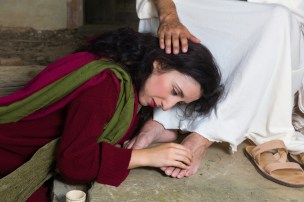
When Mary reached Jesus, she fell at His feet in anguish, crying “Lord, if you had been here, my brother wouldn’t have died.” Same words, different emotion behind it. The Bible says it was her anguish that deeply moved and troubled Jesus. He asked where they had buried Lazarus, and then He began to cry. Yes, He cried openly. As a result, some people thought, “See how He loved him,” but others started to criticize. They said, “He opened the eyes of the blind, couldn’t He have kept him from dying?” What happens next is best read in the verses themselves (John 11:38-44)…
Jesus, once more deeply moved, came to the tomb. It was a cave with a stone laid across the entrance. “Take away the stone,” he said. “But, Lord,” said Martha, the sister of the dead man, “by this time there is a bad odor, for he has been there four days.” Then Jesus said, “Did I not tell you that if you believe, you will see the glory of God?” So they took away the stone. Then Jesus looked up and said, “Father, I thank you that you have heard me. I knew that you always hear me, but I said this for the benefit of the people standing here, that they may believe that you sent me.” When He had said this, Jesus called in a loud voice, “Lazarus, come forth!” The dead man came out, his hands and feet wrapped with strips of linen, and a cloth around his face. Jesus said to them, “Take off the grave clothes and let him go.”
Most Christians use this account to share the incredible miracle of Lazarus being raised from the dead, and it IS miraculous. We hear sermons about how God always shows up right on time, even when we think He is “four days late.” We hear preachers and teachers talk about Jesus’ love for His friend and the emotion He showed in weeping openly over the situation. Those are all great things to consider, but how often do we look at how Lazarus probably felt? If I was Lazarus, I would have been ticked off! Think about this for a moment: Here’s a guy who had been really sick and was miserable. He eventually succumbed to his illness and died, but in that moment, he was immediately in the presence of God. He was in Paradise! He has no more pain and doesn’t have to worry about anything anymore. As a child of God, he is finally home. I imagine him hanging out with Moses and Abraham, or maybe some of his loved ones who had already died. What a great homecoming! What a great time! All the crap he had to endure on this earth was finally passed, and he could relax. But then, from beyond the grave, a voice calls to him, “Lazarus, come forth.” If I was Lazarus, I would be thinking, “Are you kidding me? After everything I’ve been through, You are calling me BACK?!! I’ve attained more than I could imagine and You are yanking me back into a world full of trouble, evil, pain and suffering. Leave me here!” We don’t know what actually went through Lazarus’ mind, but I think of how I would feel if it happened to me.
 There was certainly a bigger purpose for bringing Lazarus back than just relieving the grief of his family. God used that event to show who He is and that He IS who He says He is. He used it to show His power, but also his mercy and love. Look, there was no denying the miraculous nature of what happened. The Bible tells us that Lazarus was in the grave for four days already and that he stunk! No one could deny he was dead – I mean “dead” dead! There was no way to say what Jesus did was a parlor trick or anything else. It was most definitely effective! Not only that, but the disciples needed their faith strengthened, and Jesus knew that bringing Lazarus back would accomplish that. But again, what about Lazarus? What good did it do HIM to be brought back? He lost all of the perfection of Heaven, AND he would have to go through an earthly death TWICE! Is it just me, or does that seem mean to anyone else? I’ve felt bad for him on that piece, because it really feels like he got the short end of that stick. I think that’s why we don’t often talk about this piece of the story. We don’t want to think that God would purposely bring us back from something amazing – or even perfect – just to drop us back into something where we are going to have to struggle. We can say all day long that we’d be ok with it since it for His glory, but I really don’t think that’s how our hearts react when it happens.
So what was in it for Lazarus? Think about it this way:
- Lazarus got to see and experience Heaven and knew what it was like.
- Knowing what was waiting for him on the other side, and that death was not to be feared, would most likely have caused Lazarus to live with a boldness and courage he never had before or might not have had any other way.
- He got to experience what the rest of us have to take on faith. He believed God, but he actually got see his faith realized with his own eyes, ears and hands. That would definitely give you a new certainty most people don’t get.
- He was freed when he died and went to Paradise, but he was liberated when Jesus called him back to this world. One of the definitions of being liberated is “releasing someone from a state or situation that limits freedom of thought or behavior.” By coming back after experiencing what he did, Lazarus was liberated from fear and anxiety over death. He was liberated from any doubt that God’s word was true. He had seen it and it changed him.
So back to present day and all the troubles we endure in life. I don’t have the big view that God does. I know that His word tells me that “all things work together for good to them who love God and are the called according to His purpose” (Rom 8:28). I know that God loves us and cares about everything we are going through. When we cry, He cries (remember how He was moved by Mary’s grief). He knows exactly where we are, all the time. Jesus knew Lazarus was dead without anyone telling Him. He told it to the disciples even though he had not received that message from anyone. God knows what we’ve endured to get to those pleasant places in our lives – places HE has actually created. So why call us back away from those places? Because it can change us for the better if we let it. It can liberate us if we look at things differently.
 When things are going well for me, I need to stop waiting for the other shoe to drop. I’m sure Lazarus wasn’t worrying about things on earth after he died. He was simply enjoying being in Heaven. I need to do the same thing in life’s pleasant places. I need to just sit back and marvel at how true God’s word is, and that He has taken care of me just as He promised He would. I need to just relax in that place and not worry about what else might or might not happen. I’ll be honest, that is NOT a natural or easy thing for me to do, but it would be so much better for me. When we worry about what might be coming next, we drain all the joy and peace out of the pleasant places in life. When we do that, we wring the joy and confidence in God out of our lives as well. Then we wonder why we are so stressed or why God feels so far away.
In those times when we are called out of the pleasant places back into difficulties, it’s so easy to be frustrated and even angry with our Heavenly Father. We may say, “it’s ok because I know He is working this for His glory and my ultimate good,” but it often becomes just words. It hurts to be pulled back from the pleasant places. It hurts when we have to endure challenges after we think we’ve conquered them already. It is frustrating and so often causes us to immediately lose sight of everything God has done for us or how He has, in the past, brought us through trouble TO the pleasant places. We need to learn to think differently about the challenges. Rather than seeing them as a punishment or reprimand, we need to recognize that God needs people in this world who have seen first-hand what He can and will do. He needs people who have unshakable confidence in our eternity so that we can live liberated lives here. He needs people living courageous lives, in spite of their circumstances, because that kind of life touches and changes the lives of others. Through that kind of life, we have opportunities to share what we have seen and know to be true about our God who loves us so much.
One last thought about this story: Notice that Jesus called Lazarus by name. He didn’t just come back to the grave and say, “come out.” Do you know why? Because if He had done that, everyone who was dead would have come out. He specifically called to Lazarus because God does not operate in generalities. He operates specifically, personally, on a one-to-one basis. He has specific plans for each of us, and each of us has a different journey to walk. In spite of our different callings, God wants ALL of us to have peace, confidence and joy.
 So the next time I hear, “Deanna, come forth,” I’m going to take a quick look around before I leave the amazing place in which I’m standing, and consider all He did to deliver me from trials in the past. By doing that, I can walk back into this flawed world with complete confidence and security in the truth of His word. Only then can I live a liberated life, free of worry and fear in my circumstances, because I have seen His glory and His fulfilled promises first hand. THAT knowledge and experience in the pleasant places is what will change the way I live in every place else.
Blessings!
 Well, we’ve just come through the first week of 2018 and have heard the words “Happy New Year” over and over. We rang in the New Year in all different kinds of ways, and now we are back to the day to day grind. Some of us made promises to do something different this year, while others are just trying to not rock the boat and keep things the same. So now what? And why do so many of us focus on making changes at this time of year? Is it because we are unhappy with the current state of our life or is it because we are discontent with decisions we’ve made in the past. Change at the turn of the New Year is enticing because, after all, who doesn’t want a clean slate (or even a “do-over”)?
 Change is a constant part of our lives. It happens to us all the time, often against our wishes. When things are going well, we don’t want change. When things are going poorly, we want change, but only on our timetable and on our terms. Real change often interrupts our intent to change. We make promises to ourselves (or others) to do something different but then something outside out control happens, and we are derailed. How many of you are dealing with unexpected changes right now? Some of us are dealing with difficult changes in our jobs, families, health, etc. Some of us suddenly find ourselves as patients while others have been thrust into the role of a caregiver. It is difficult when the New Year brings change to you instead of you bringing change to the New Year. There are also positive changes for some of us. Some have become parents, homeowners, financially stable, and many other things. It isn’t about whether or not change will happen, but how we deal with it.
 There is truly a time for everything, and our definitions of good and bad are usually based on limited information. The question is: do we trust the One who actually knows everything or not? Are we going to live through the changes in life like a wind-up toy, going along until it hits a wall and then bounces off and goes another direction until it hits another wall? The reality is that we really do have a choice and the result of our choice will either bring peace or anxiety. If we approach unexpected change as though it is totally up to us to figure out the problem and fix it, then we are going to live a life full of constant stress, because there will always be circumstances we cannot control. On the other hand, if we could realize that what we see as “unexpected” is never a surprise to our Heavenly Father, and that He has promised He is working all things for our ultimate good, then we can live a life of confidence and peace in the midst of every storm. It doesn’t mean it will always feel good, but we can trust that it will eventually all work out.
 So I wish you all an amazing 2018! It is my prayer that all of us can learn to lean on what we know in our hearts instead of going it alone. We can become better parents, children, employees, bosses, church members, pastors or whatever other role we may fill. The best way to do that is to fall back into our Father’s arms and let Him show us the paths to walk. And when the next January 1st rolls around, we will be able to share not only our hopes for another year, but our resolutions – our results – from the journey we are embarking on right now. That, my friends, is what a resolution is all about.
 Sometimes it can get really discouraging when you are continually faced with people who are not honest. We’ve all been there, those times when you are either lied about or lied to. Sometimes it is intentional, and sometimes it happens out of exaggeration without thinking. Either way, it reveals something about a person’s true character when it happens, and if it is us doing the lying, it reveals the same about our character as well. Recently, I have been lied about and lied to. When it occurred, I was both discouraged and disturbed by it. Although I forgave the people involved and tried to understand why it might have happened, I lost a great amount of (if not all) respect for them. I was blessed to have had the lie revealed in these situations, but that doesn’t happen every time. Sometimes we just have to continue walking in integrity and trust that God will take care of the situation(s) in His time and in His way, even if we never know it happens or get to see the result.
 The only way to battle dishonesty is with truth. If we try to battle against lies with reason or even anger, we will probably just end up frustrated with the results. That’s because lies breed other lies! When someone lies to or about you, and they are confronted, don’t be surprised if another lie is told to try and get out of the uncomfortable or awkward position in which that person finds themselves. Depending on the reason for the untruth in the first place (as mentioned above), that same force will often drive a second or third lie in order to cover it up or keep the charade going. The ONLY way to face dishonesty is to shine the light of truth on it. But before you start cheering, “Yeah, expose it,” we probably need to consider something else.
 As people of faith, we know the guidelines of forgiveness. We know we are to love our enemies and pray for those who mistreat us (Matt 5:43-48). On one occasion, Peter asked Jesus how often he needed to forgive, thinking seven times was plenty. Jesus responded with “seventy times seven” (Matt 18:21-22). That doesn’t mean 490 times and then stop, but rather that forgiveness is a process. We are human, and forgiveness does NOT come easy to us. It isn’t usually enough to forgive someone just once and walk away. In our hearts, we tend to hold grudges and hang onto hurt, pain, and betrayal. We may not outwardly give someone a cold shoulder or treat them poorly, but inside we often have to forgive them every time the hurt, anger or pain rears its head again. We need to forgive so that we can let it go. We need to sometimes forgive over and over internally until we reach that point. We read in Matt 18:23-35 about a servant who was forgiven of a huge debt he had no way of ever paying back. He begged for mercy and forgiveness and his master granted it and forgave his debt – lavishly! Almost immediately, that same guy went out to someone who owed him a very small amount and when that man begged for mercy and forgiveness, the guy not only didn’t forgive the debt, but he threw the man into prison. When the master found out, he went back to the servant and scolded him for his lack of mercy. As a result, he also rescinded the debt forgiveness and put him into prison himself. Jesus follows this parable with the statement, “This is how the Heavenly Father will treat each of you unless you forgive your brother or sister from your heart.” OUCH!
 As I said earlier, “lies are complicated,” and spending our energy trying to figure out why someone is dishonest will rarely bring an answer we find satisfying. Lies or misrepresentations can quickly become a web in which most of us do not want to be stuck – no matter if you are the spider or the fly. Instead of focusing so much on the dishonesty we come across almost every day, wouldn’t it be better to focus on the truth? Turning from anger to forgiveness frees us to live abundantly. And if, perchance, you are struggling with a “justice gene” of your own, maybe it’s time to go back to that model prayer Jesus gave us. Maybe it’s time to remember how lavishly we have been forgiven, with no strings attached, by the One who has every right to demand justice, but instead, chooses love.
 Lately I’ve been thinking a lot about the spiritual battles we face in this life. At times, I really struggle to hang onto my faith when the enemy continually tries to get me to doubt what I know to be true about God and His nature toward us as His children. I mean, I know the right things to say and even think, but it is so easy to get caught up in fear, frustration, sadness and a host of other emotions when we are faced with life’s difficulties. Even the apostle Paul shared his struggle with the battle between our human nature and our spiritual one. He said, “What I want to do, I don’t do, but what I hate, that’s what I do. I don’t do the good I want to do, but I do the bad that I don’t want to do, and then keep on doing it.” Man, he sounds a a lot like me. Paul explains that it is his sin nature that causes such a problem because once we are saved, we know what we should do, but we often struggle to follow through with it. Not only that, we struggle what to think, which then causes confusion in our emotions as well. It’s easy to see why we are so often tangled up within ourselves, walking the line between fear and faith or doubt and trust.
 Our enemy KNOWS his eventual fate. The judgement and sentence has been declared and sealed! Revelation chapter 20 describes exactly what awaits him. He knows how it all ends, and yet he still has his last 24 hours of freedom before it all comes to pass. He cannot run or hide from his fate, so he is determined to wreak as much havoc as he possibly can until that time. He is continually trying to keep the unsaved from believing in Christ, but his greater successes come in trying to keep saved children of God from living the abundant life God has promised to us. I will always believe that Satan’s greatest accomplishments come within churches full of believers. God has promised to reveal himself to ALL men (Titus 2:11), so Satan can’t keep someone from the reach of God. He has a much better chance at getting Christians to fall away from the truth than preventing someone from hearing, seeing, or knowing it. Satan loves to blind people. He loves to turn believers into unbelievers. 2 Corinthians tells us that he blinds the minds of the unbelievers to keep them from seeing the light of the gospel. I think we’ve done a huge disservice in taking this as referring to only those who have not accepted Christ as their Savior. Yes, Satan can blind the unsaved so that it is harder for their hearts and minds to be opened, but he does NOT have the power to keep God from reaching them. GOD IS ALL POWERFUL! So then we have to look at that verse a little differently.
 My relationship with God has shifted from a good relationship to an intimately personal one. As a result, I have learned to relax IN HIM instead of relaxing because of Him. There is a huge difference between knowing all the right verses and knowing Him. There is a difference between seeing Him as a loving entity who can help you and recognizing Him as a Dad – as your “Abba Father.”
 I’ll leave you with this last thought: We are also living in our own 24 to life period. We all have a finite number of years on this earth. Once those years are gone, we lose our opportunity to reflect the love and nature of our Father in Heaven to those here on this earth. We lose the chance to make things right with the people in our lives. We lose the chance to leave a positive mark on our own little corner of the world. I don’t know about you, but I want the people who know me to look at me and say, “She is her Father’s daughter.” I want people to see His nature in me because I love and forgive. I want them to see someone who struggles with worry and fear but who also steps back and remembers the truth so that I have peace and contentment. I am living 24 to life. Though that “life” means eternity of peace and joy in Heaven, I want my “24” down here on Earth to not only be abundant for me in all ways, but to be an abundant encouragement and strength to everyone around me. I pray that for myself, and I pray that for all of you too.
 Most of you have at least heard of the story in Exodus 14 of the people of Israel being trapped in front of the Red Sea with no way out. There was impassible terrain on both sides, they were being pursued from behind by Pharaoh’s army, and there was a sea in front of them. Death and destruction seemed certain, but God had actually
  I mentioned there were TWO times where God parted literal waters to make a way for His people. The first was the Red Sea, but the other was Jordan River. The people of Israel were still journeying along the path God was directing them, carrying the Ark of the Covenant (Joshua chpt 3). They arrived at the edge of the Jordan River, and there was no way for them to cross. This was the time of year the river ran so high and swiftly that it would overrun its banks. It was a rushing, flooding river! God instructed Joshua that when the people come to the brink of the flowing waters of the Jordan, the priests who were carrying the Ark were to “stand still IN the Jordan.” Joshua passed the message along, and they did as they were told. As a result, the waters parted, and the people passed across on DRY GROUND! Sound familiar? Wait until God tells you to do otherwise and He will make the way clear. There is a glaring similarity in these two events: God’s direction was to “stand still” and He would provide a way. On the other hand, there is also a glaring difference. At the Red Sea, the people were to stand still and watch God open the path ahead. The sea parted before anyone stepped into it. At the Jordan River, the men were told to stand still IN the Jordan first and then God would open the path. The waters didn’t part until AFTER they stepped in.
 Standing still isn’t easy. Waiting for God to open doors and paths in our lives isn’t easy, but knowing where we are supposed to stand still is an even tougher dilemma for us. Are we (am I) standing at the edge of the sea or the raging river? How do I know if I am waiting on God to move, or if God is waiting on me to step into the water first? Are we at a standoff of faith? Am I misinterpreting my role in this journey? Questions flood our minds when we are struggling. We question why God isn’t opening the path before us or why He doesn’t seem to be moving. We strain our eyes for signs of where we are supposed to go or what we are supposed to do. Do we wait or do we leap? My friends, God is not the author of confusion! (1 Cor 14:33) He is continually leading us in all different ways – some are obvious and some are subtle, but all are powerful if we are willing to follow. God may drop a sign as obvious as a pillar of fire or cloud in front of you and say “follow that,” or you may have to rely simply on His words. You may be led to a dead end and told to stand still on the banks of the ocean and wait, or you may be told to step INTO the waters first and wait for them to part. I think most of us probably prefer waiting for the path to open before we embark upon it. We like to see it before we walk it. There are some, however, who actually prefer jumping into the river first and then seeing the path emerge.
 The “Jordan River” brings a total different type of stress. I’ve been there too. There isn’t the same urgency of survival that happens at the “Red Sea.” You aren’t trapped and no one is actively pursuing you to destroy you. You are simply lacking direction. It isn’t hard for us to stand still in these times because the status quo can be an addictive drug. When there isn’t an urgent threat, it’s easy to just stick with what you know, but we find ourselves in situations where we are driven to fear, depression, and anxiety. We know God has the ability to deliver us, but we can see different options or paths for that to happen. As a result, we become paralyzed because we don’t want to give up what we have if God hasn’t shown us the path yet. We don’t make the leap because we fear we will be worse off than we are now. “Better the devil you know than the devil you don’t,” right? So we give up joy, peace and contentment for the sake of stability and safety. The stress of the Jordan doesn’t come from having to calm yourself to be still in the face of a charging enemy; it comes from having to get the courage to let go of safety and stability FIRST and then wait for God to reveal the path. Let me add one other thought here. God told them to step into the raging flood waters and THEN to stand still. He didn’t tell them to step in and keep walking. Our tendency at the Jordan is to say, “I know God wants me to step into the river and He will show me the way.” What we forget is the very next step after leaving the safety of dry land, is to stand still in the unknown. The fear and anxiety that comes with the Jordan comes from letting go of a sure thing and seemingly risking everything. It comes in doing making the leap and then having to calm yourself as the flood waters rush around you. It comes in trying to stand while the force of your circumstances are trying to pull you under. Instead of asking God “Why did you bring me here to be destroyed,” we ask ourselves, “What was I thinking?!” We start questioning if we did the right thing, because destruction seems certain as a result of our decision. We experience the elation of courage, only to be hit with the panic of survival. We step in, but when the way isn’t immediately made clear, we step back out and wonder why we still don’t see a path. That isn’t God’s fault; it’s ours.
 No matter where you find yourself today, standing at the Red Sea or the Jordan, don’t panic. God is with you, leading you forward. He isn’t holding His will behind His back and making you play a game to try and figure it out. If you truly want direction, and are in fellowship with your Father, then He will reveal it to you. You may still be asking, “But how do I know?” Proverbs 3:5-6 says, “Trust in the Lord with all your heart and lean not on your own understanding. In all your ways, acknowledge Him, and He will direct your path.” Notice the little word in the middle – “all. That little word leaves no room for creating your own directions or forging your own path. Are you the master of your destiny? Yes, absolutely. You have complete freedom of choice to live your life how you choose. You can go it alone, bumping into walls, frustrated and always seeking direction, or you can acknowledge God in ALL your ways and He will provide the direction for which you are seeking. If you want to know which way to go, then get humble, surrender your will to His in every area, and then listen to that still, small voice within. He has promised He will lead us; we simply need to be willing to stand still first, and then follow where He leads.
 The Cadence of My Soul