
 How many times have you found yourself overwhelmed and burned out? If you are like me, it’s probably been more than once! I say all the time that we get thrown into so many circumstances in life and even if there are a lot of good things (by our definition), the amount of activity just seems to keep increasing, and it totally wears us out. That’s where I find myself now, and I’m sure many of you can relate.
So how do you know when the candle you’ve been burning at both ends is about to disappear? Well, first there are the obvious clinical signs like:
- Exhaustion – physical and/or emotional
- Physical health issues – headaches, dizziness, chest pains, illness, etc.
- Mental health issues – anxiety, depression, anger or hopelessness
- Forgetfulness or having trouble concentrating
- Apathy
- Increased irritability
- Lack of productivity, poor performance or feeling like you never accomplish anything
- Pessimism or cynicism
- Isolation
Although I have been here before, this time around has brought some enlightening revelations that I just had to share.
I will not go into all the many things that are wearing me out these days, but suffice it to say I am being hit from all sides in all kinds of different ways. I have found myself in my car, heading to someplace I have responsibilities (work, church or home), sobbing and telling God, “I can’t do this anymore!” It is simply overwhelming. No one wants to live with a constant barrage of difficult circumstances, and yet when I look around me, it seems like so many of us are in that place most of the time. So I started wondering what I am taking on that is not my responsibility, and this is where my thoughts had to unravel a little so that they could come back together more appropriately.
 I was raised with a sense of responsibility and accomplishment. I have always tried to be the best at what I do, but more importantly I have tried to love and serve God and others in every way possible. I’ve been active in church all my life, worked successfully at my job, and had all kinds of other interests and activities. My point is that I am not one to sit on the sidelines, and it is important for me to feel like what I am doing makes a difference for others. That all sounds great, until I began to realize my positive drive becomes warped when my sense of responsibility gets skewed.
Many of us take on far more responsibility than necessary for certain things in life. I realize there are also a lot of people who take NO responsibility for anything which makes the rest of us feel as though it is our job to pick up the slack. After all, if we don’t do it, who will? There is some truth in that question, but we need to be careful that we aren’t falling in love with being the “doer” or getting our fulfillment from being superhuman (or thinking we are). I admit fully I have been in that exact cycle at times in my own life. It feels good to get all kinds of stuff done! It feels good to help everyone. It feels good to plan and execute events, etc., but lately there have been a few situations that have brought to my attention the fact I have started mistaking my desire for my responsibility. That, my friends, is a dangerous mindset, because it means burnout is already upon us or barreling toward us at a high rate of speed! I mentioned that I have been wondering what I’ve taken on that is not my responsibility. What am I doing to myself that is adding to my own burnout these days? The answer is that I have been taking on misplaced responsibilities.
We all have areas where we have to rely on a leader of some kind. (I use the term “leader” loosely, as many so-called leaders do not actually lead.) In our jobs, we have Supervisors/Owners. In our churches we have Pastors. In volunteer work we have Executive Directors. You get where I’m going with this. The problem is when leaders don’t actually LEAD, everything starts falling apart. Even Proverbs 29:18 warns us, “Where there is no vision, the people perish.” There are countless examples of organizations, churches or companies that have died off because of a lack of leadership. When that happens, people try to find all kinds of reasons for the failure of a company, church or even a family, when the truth is there was no leadership!  When leaders become so engrossed in themselves, or so detached from the people they are supposedly serving, there is chaos. That chaos may not always manifest in external ways, but internally it leaves people feeling alone and without support or direction. That’s when you see informal leaders appear, and often those people are not always operating with the best intentions; sometimes they are seeking control. I will add though, sometimes there are also very good people who are simply trying to step up and keep things going in the absence of appropriately placed leadership. When leaders don’t lead, it begins a vicious cycle that only stops when the he or she takes a hard look in the mirror and changes, or you get a new leader. Aside from one of those two things, “the people perish.” Do you know whose responsibility it is to lead? THE LEADER’S!
So back to the revelation about responsibility and burnout that struck me so hard it changed my thinking. I realized that although the good I have been trying to do in certain areas of life has been sincere and from a heart of love, there was/is an extra element of compensating for what I perceive to be a lack of leadership. I’ve been here before, but this time it was like God opened up the sky and shined a huge light right down on this perception. You see, there are some areas in life where you can only do so much. We should always do what God calls us to do and let Him handle the results, but when there is no life or passion in those around you, people are perishing. There is no amount of effort you or I can put into an organization of any kind that will effectively substitute for a lack of leadership from the person who holds the official position of leader, regardless of the title by which it is called. And if it IS possible for us to keep holding things together when a leader won’t lead, then we have much bigger problems than lifelessness or a lack of passion.
It is a hard thing to realize, no matter how much we love or care about our jobs, churches, volunteer work, etc., there is no amount of effort we can put in that will substitute for leadership. I’m not saying we can’t step up and be leaders in some of these areas, but when THE leader won’t (or can’t) step up and fulfill their responsibilities, our efforts will so often result in a burnout that scorches us at the very core. It not only burns us out, it changes what was intended for good into something that is unhealthy for us. We can only keep pressing on when we realize that some things are not our responsibility.
For a person of faith, God is my ultimate leader and guide. It is my responsibility to follow where He leads and do what He calls me to do. The rest is up to Him. What we do in life is important; there’s no question about that, but how we do it is even more important. When I start feeling like everything rests on my shoulders, I have misplaced my focus and energy. And when that happens, the fire within starts to suffocate and burnout is inevitable. I have had the opportunity to lead others in many different endeavors and situations, and it is a responsibility I take very seriously. I know what it is like to wither under a lack of leadership, and I know that God can do amazing things when we simply submit to Him and let Him do the heavy lifting.
So today I am struggling with the fact that I can’t fix some things that are broken. I’m struggling with the possibility of what God might be doing or how/where He is moving because it is unknown to me, even though He sees what I cannot. I am exhausted and discouraged by the path I have been walking and the lack of passion I see in others that I cannot ignite. It is my responsibility and my honor to pray for the people in leadership that affect me. It is my responsibility to love others and to forgive without judgment or condemnation. It is my responsibility to follow, unashamedly, wherever God leads. It is my responsibility to be and act as I am called to be and act. I will continue to ignite passion wherever God calls me to be a light, but it is time to let go of the responsibilities that He has placed on someone else.
It is my prayer that we will all take a deep breath and remember not everything is our responsibility. It’s time to stop trying to make up for what is lacking in others and step back to refocus. Without vision, the people perish. A lack of leadership can be scary, discouraging, frustrating and depressing, but thank God He has promised to lead and guide us no matter our circumstances. He is a God of passion not apathy, so if you are a leader, then lead! And if your leaders are not leading, then seek God’s direction on the path ahead. If we are seeking Him, He will make it clear.
Blessings!
 Well, we’ve just come through the first week of 2018 and have heard the words “Happy New Year” over and over. We rang in the New Year in all different kinds of ways, and now we are back to the day to day grind. Some of us made promises to do something different this year, while others are just trying to not rock the boat and keep things the same. So now what? And why do so many of us focus on making changes at this time of year? Is it because we are unhappy with the current state of our life or is it because we are discontent with decisions we’ve made in the past. Change at the turn of the New Year is enticing because, after all, who doesn’t want a clean slate (or even a “do-over”)?
 Change is a constant part of our lives. It happens to us all the time, often against our wishes. When things are going well, we don’t want change. When things are going poorly, we want change, but only on our timetable and on our terms. Real change often interrupts our intent to change. We make promises to ourselves (or others) to do something different but then something outside out control happens, and we are derailed. How many of you are dealing with unexpected changes right now? Some of us are dealing with difficult changes in our jobs, families, health, etc. Some of us suddenly find ourselves as patients while others have been thrust into the role of a caregiver. It is difficult when the New Year brings change to you instead of you bringing change to the New Year. There are also positive changes for some of us. Some have become parents, homeowners, financially stable, and many other things. It isn’t about whether or not change will happen, but how we deal with it.
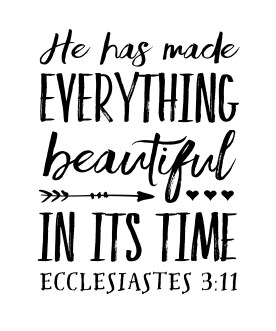 There is truly a time for everything, and our definitions of good and bad are usually based on limited information. The question is: do we trust the One who actually knows everything or not? Are we going to live through the changes in life like a wind-up toy, going along until it hits a wall and then bounces off and goes another direction until it hits another wall? The reality is that we really do have a choice and the result of our choice will either bring peace or anxiety. If we approach unexpected change as though it is totally up to us to figure out the problem and fix it, then we are going to live a life full of constant stress, because there will always be circumstances we cannot control. On the other hand, if we could realize that what we see as “unexpected” is never a surprise to our Heavenly Father, and that He has promised He is working all things for our ultimate good, then we can live a life of confidence and peace in the midst of every storm. It doesn’t mean it will always feel good, but we can trust that it will eventually all work out.
 So I wish you all an amazing 2018! It is my prayer that all of us can learn to lean on what we know in our hearts instead of going it alone. We can become better parents, children, employees, bosses, church members, pastors or whatever other role we may fill. The best way to do that is to fall back into our Father’s arms and let Him show us the paths to walk. And when the next January 1st rolls around, we will be able to share not only our hopes for another year, but our resolutions – our results – from the journey we are embarking on right now. That, my friends, is what a resolution is all about.
 Most of you have at least heard of the story in Exodus 14 of the people of Israel being trapped in front of the Red Sea with no way out. There was impassible terrain on both sides, they were being pursued from behind by Pharaoh’s army, and there was a sea in front of them. Death and destruction seemed certain, but God had actually
  I mentioned there were TWO times where God parted literal waters to make a way for His people. The first was the Red Sea, but the other was Jordan River. The people of Israel were still journeying along the path God was directing them, carrying the Ark of the Covenant (Joshua chpt 3). They arrived at the edge of the Jordan River, and there was no way for them to cross. This was the time of year the river ran so high and swiftly that it would overrun its banks. It was a rushing, flooding river! God instructed Joshua that when the people come to the brink of the flowing waters of the Jordan, the priests who were carrying the Ark were to “stand still IN the Jordan.” Joshua passed the message along, and they did as they were told. As a result, the waters parted, and the people passed across on DRY GROUND! Sound familiar? Wait until God tells you to do otherwise and He will make the way clear. There is a glaring similarity in these two events: God’s direction was to “stand still” and He would provide a way. On the other hand, there is also a glaring difference. At the Red Sea, the people were to stand still and watch God open the path ahead. The sea parted before anyone stepped into it. At the Jordan River, the men were told to stand still IN the Jordan first and then God would open the path. The waters didn’t part until AFTER they stepped in.
 Standing still isn’t easy. Waiting for God to open doors and paths in our lives isn’t easy, but knowing where we are supposed to stand still is an even tougher dilemma for us. Are we (am I) standing at the edge of the sea or the raging river? How do I know if I am waiting on God to move, or if God is waiting on me to step into the water first? Are we at a standoff of faith? Am I misinterpreting my role in this journey? Questions flood our minds when we are struggling. We question why God isn’t opening the path before us or why He doesn’t seem to be moving. We strain our eyes for signs of where we are supposed to go or what we are supposed to do. Do we wait or do we leap? My friends, God is not the author of confusion! (1 Cor 14:33) He is continually leading us in all different ways – some are obvious and some are subtle, but all are powerful if we are willing to follow. God may drop a sign as obvious as a pillar of fire or cloud in front of you and say “follow that,” or you may have to rely simply on His words. You may be led to a dead end and told to stand still on the banks of the ocean and wait, or you may be told to step INTO the waters first and wait for them to part. I think most of us probably prefer waiting for the path to open before we embark upon it. We like to see it before we walk it. There are some, however, who actually prefer jumping into the river first and then seeing the path emerge.
 The “Jordan River” brings a total different type of stress. I’ve been there too. There isn’t the same urgency of survival that happens at the “Red Sea.” You aren’t trapped and no one is actively pursuing you to destroy you. You are simply lacking direction. It isn’t hard for us to stand still in these times because the status quo can be an addictive drug. When there isn’t an urgent threat, it’s easy to just stick with what you know, but we find ourselves in situations where we are driven to fear, depression, and anxiety. We know God has the ability to deliver us, but we can see different options or paths for that to happen. As a result, we become paralyzed because we don’t want to give up what we have if God hasn’t shown us the path yet. We don’t make the leap because we fear we will be worse off than we are now. “Better the devil you know than the devil you don’t,” right? So we give up joy, peace and contentment for the sake of stability and safety. The stress of the Jordan doesn’t come from having to calm yourself to be still in the face of a charging enemy; it comes from having to get the courage to let go of safety and stability FIRST and then wait for God to reveal the path. Let me add one other thought here. God told them to step into the raging flood waters and THEN to stand still. He didn’t tell them to step in and keep walking. Our tendency at the Jordan is to say, “I know God wants me to step into the river and He will show me the way.” What we forget is the very next step after leaving the safety of dry land, is to stand still in the unknown. The fear and anxiety that comes with the Jordan comes from letting go of a sure thing and seemingly risking everything. It comes in doing making the leap and then having to calm yourself as the flood waters rush around you. It comes in trying to stand while the force of your circumstances are trying to pull you under. Instead of asking God “Why did you bring me here to be destroyed,” we ask ourselves, “What was I thinking?!” We start questioning if we did the right thing, because destruction seems certain as a result of our decision. We experience the elation of courage, only to be hit with the panic of survival. We step in, but when the way isn’t immediately made clear, we step back out and wonder why we still don’t see a path. That isn’t God’s fault; it’s ours.
 No matter where you find yourself today, standing at the Red Sea or the Jordan, don’t panic. God is with you, leading you forward. He isn’t holding His will behind His back and making you play a game to try and figure it out. If you truly want direction, and are in fellowship with your Father, then He will reveal it to you. You may still be asking, “But how do I know?” Proverbs 3:5-6 says, “Trust in the Lord with all your heart and lean not on your own understanding. In all your ways, acknowledge Him, and He will direct your path.” Notice the little word in the middle – “all. That little word leaves no room for creating your own directions or forging your own path. Are you the master of your destiny? Yes, absolutely. You have complete freedom of choice to live your life how you choose. You can go it alone, bumping into walls, frustrated and always seeking direction, or you can acknowledge God in ALL your ways and He will provide the direction for which you are seeking. If you want to know which way to go, then get humble, surrender your will to His in every area, and then listen to that still, small voice within. He has promised He will lead us; we simply need to be willing to stand still first, and then follow where He leads.
 Our society places a lot of value on beauty and outward appearance. We think nothing of having work done (or of others having work done) to try and circumvent the effects of aging, and yet we are paying less and less attention to how we look on the inside. We are losing our ability to be civil and courteous, and nowhere is this truth more apparent than on Facebook and other social media sites. Over the past 6 months or so, I have been spending less time on Facebook and much of the time I’ve spent was, or is, hiding posts from people on ALL sides of varying issues (political or other). My tolerance for the intolerance shown by so many people on so many subjects has really worn thin. Before I go any further, let me just say that if you think I’m one of those people who just wants to stick their heads in the sand and not care, or are not willing to be engaged in thoughtful or even passionate discussion, I can assure you nothing is further from the truth. I choose to be very engaged, just not online.
 That’s part of what is wrong with instant news. Stories used to have time to develop before everyone heard something and reacted. We’ve seen many stories that turned out not to be as they were originally portrayed, but it was too late to stop the reactions or public opinion – even when the facts finally come out. On top of that, there is so much “fake” news that now exists for the sole purpose of stirring people up, or even worse, slandering or attacking them.
 We don’t walk away from people who are rude or aggressive anymore, instead we devolve into them ourselves. We forget that we are talking to human beings, and instead treat each other like animals. We are bullies. We are arrogant and insensitive asses. We devolve into everything we say we aren’t or that we preach against. We watch our friends tear each other down and just sit there. We think, because we don’t read or react to the garbage that rolls through our feeds, that it isn’t affecting us. But it is. It wears on us until we finally crack. I’ve fallen victim to it on several occasions myself. “It” being that almost uncontrollable urge to fight back or snipe back at someone who is being unreasonable or, God forbid, wrong! I’ve given into it on occasion, but it has almost always come with regret at some point.
 So why does it matter? It matters because we are conditioning ourselves in ways that are harming us as individuals and as a society. Our “real” lives are in turmoil. We hear of tragedies almost daily where someone has attacked or even killed others. We hear of relationships of all kinds falling apart and everyone is more concerned with blaming each other and making sure they are the one who comes out “looking good.” We watch kids bully and be mean to each other but then whine and cry when someone does the same to them. We wring our hands and wonder why this selfish behavior has become so common, but we refuse to look in the mirror and admit we are part of the problem. Whether we are actually fighting or being a voyeur, we are part of the problem. We are more and more desensitized which makes us less and less self-aware. In our “real” lives, we are becoming quicker to point out others who are being rude, offensive or a host of other negative traits while not seeing our own.
 We are ALL humans. We are all imperfect and we all are tempted to get caught up in the drama with which we are constantly bombarded. Instead, let us hold each other close in heart. Let us truly love each other instead of tearing each other down. Let’s purge our social media feeds AND our lives of the things that continually remind us of how we are different we are and start looking at how we are all the same. Yes, it’s time for a “face”lift of a different kind, so I will leave you with this: “Therefore, we do not lose heart. Though outwardly we are wasting away, yet inwardly we are being renewed day by day.” (2 Corinthians 4:16)
 There is a very familiar song from a very popular movie that continually tells us to “let it go.” Not a bad thought considering how many things in life seem to take us down in one way or another. We are hit continually with circumstances beyond our control – jobs, family issues, health issues, even the political climate – all of it can just wear us down to the point we truly feel like we cannot get up one more time. After all, why get up when life is just going to knock you back down again? That seems like a very valid question, doesn’t it? Of course it does, until you remember something all people of faith forget: Our circumstances may be out of our our control, but they are never out of God’s.
 God never meant for us to hoard things in this world. He never wanted us to put down roots here when our forever home is actually with Him. “Yeah, yeah, but that’s just a nebulous concept when I’m living in the NOW.” We really struggle with letting go of anything! The things we consider “good” in life (money, secure jobs, good relationships, homes and possessions, etc.) are hard to let go of because we think if we “let it go” that means we lose it. The things we consider “bad” (money, secure jobs, bad relationships, possessions we’ve acquired, etc.) are hard to let go of because they are familiar and serve a purpose for us – even if that purpose is less than desirable. What we have is what we know, and we don’t like to consider the unknown. We don’t want to consider that letting go means everything might change. Letting go of the “good” means we lose and letting go of the “bad” means everything will be unfamiliar. After all, either way, what if we let it go and then don’t make it? What if we don’t survive? What if, what if, what if?
 Life is difficult. We were never promised it would be easy, but it can be rich and fulfilling if we can learn to let things go. When we learn to let go, we also learn to embrace. Hurts that we have endured through various means or people can cripple us forever if we let them. People who have let us down, angered us, treated us poorly or unfairly, or rejected us completely don’t have to diminish us. Situations that have (or are) less than perfect don’t have to destroy us. We don’t have to hold onto our grudges or hurts. We don’t even have to hold on to our expectations that have gone unfulfilled. We probably need to readjust those expectations anyway. We, especially as people of faith, have a problem. We hold ourselves in such high regard that we feel like we have a right to hold onto our anger and hurt. We think so highly of ourselves that we feel entitled to NOT let things go. We think it is our right to make sure everything is eventually evened out in our world and that we are treated fairly, and we spend a lot of our time, energy and resources to ensure it happens. I have news for you: making things “fair” is not your responsibility. Do you know what IS your responsibility? Loving God, loving each other and letting things go.
 Stop trying to cling to the familiar or to your desire to see that others get what you think they deserve. Quit holding onto your wounds as badges of honor and be willing to let the wounds in your heart heal. Let it go. Open your heart and let go of the pain from those who didn’t love you and embrace the One who does. And when the circumstances in your life start overwhelming you, or you feel that need for revenge start to rise within you, let it go. It isn’t worth it. We were never meant to carry around the weight of the world with us. We can do exactly what God’s word says in 1 Peter 5:7 – “Cast your cares on Him because He cares for you.” When we do that, we can still see the sun, no matter how the storms may rage around us. We can say, with great assurance, “Here I stand in the light of day. Let the storm rage on, the cold never bothered me anyway.”
 The Cadence of My Soul